

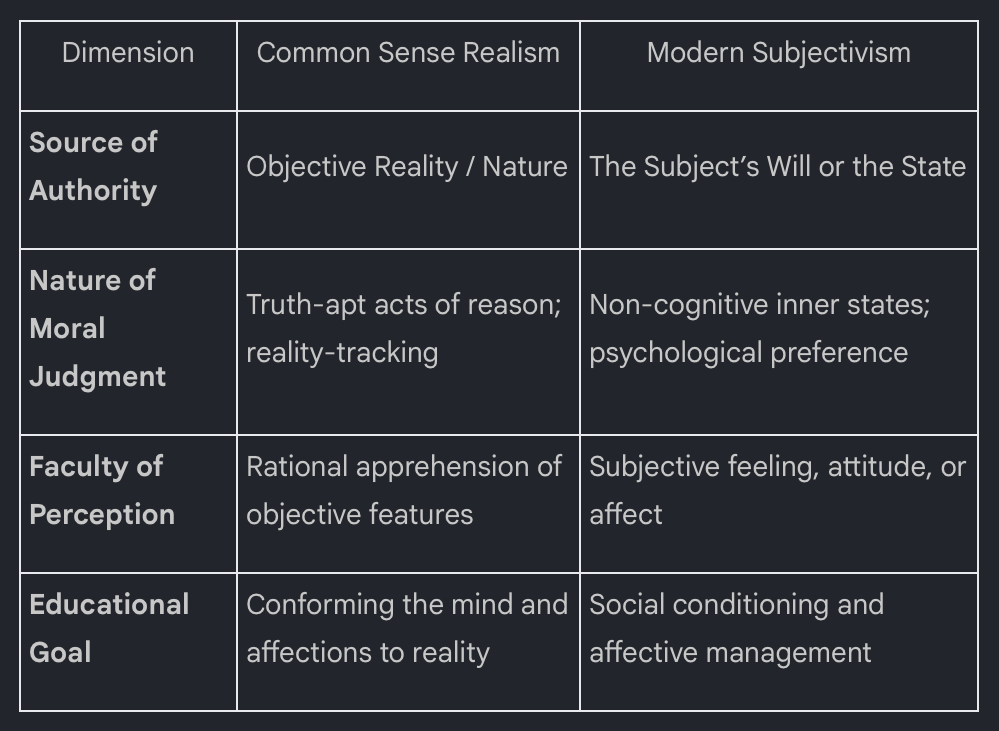
The current crisis in Western educational infrastructure is not merely the result of shifting pedagogical trends, but the consequence of a profound category substitution at the level of foundational metaphysics. The transition from Common Sense Realism to Modern Subjectivism represents a fundamental re-engineering of the curriculum architecture. This shift replaces the rational apprehension of objective reality with the prioritization of non-cognitive psychological states, effectively altering the DNA of institutional mandates. By redefining how the human subject interacts with truth, this pivot neutralizes the concept of an external moral order without necessitating a formal refutation. It is a strategic strike against the epistemological foundations of the Western tradition, rendering objective truth inadmissible within the modern classroom setting.
Metaphysical Foundations of Education
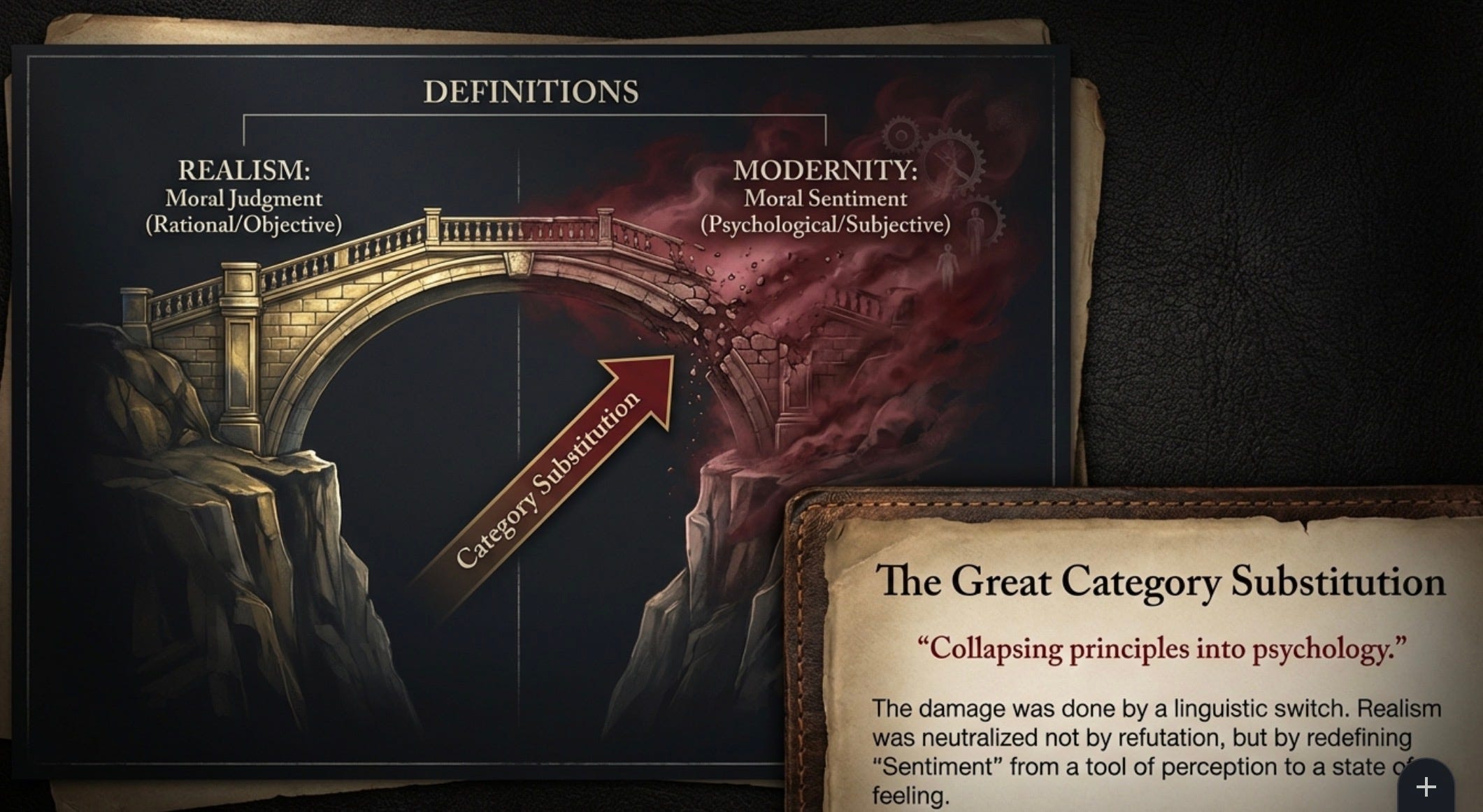
This strategic misclassification collapses principles into psychology - in practise, negating what principles are in substance and operation.


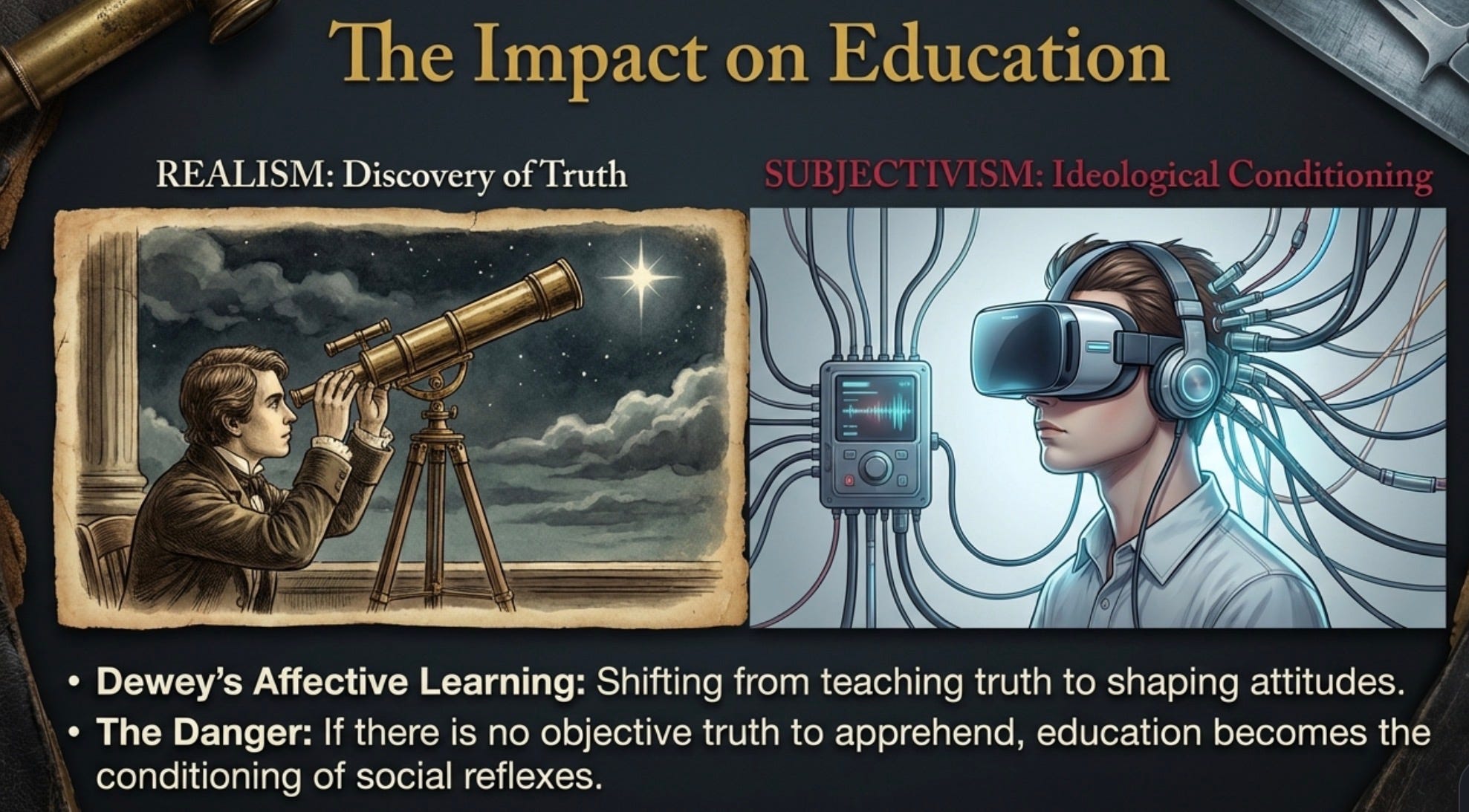
When moral judgments are stripped of their cognitive status and redefined as mere ‘sentiments’, they lose their authority to bind. Policy analysts have either failed to understand (or worse subversively - have understood!) that if a moral statement is merely conveyed as ‘an expression of an inner feeling’ (e.g., ‘I feel this is wrong’ v ‘This is objectively unjust’), then the individual becomes ‘negotiable’ -an object to be managed by planners rather than a rational agent answering to truth. This transition from objective to subjective provided the theoretical framework for the historical agents who would operationalize this subversion through systemic teacher training at scale.
The Institutional Pipeline
Operationalizing the Poison through Behaviourism and Pedagogy
The institutionalization of subjectivism was a deliberate movement from academic idea laundering to systemic implementation within teacher training programs. This process successfully embedded a subjectivist ‘operating system’ into the heart of civic infrastructure, converting education into the very mechanism of subversion for affective management.
Wilhelm Wundt’s Leipzig Lab Behaviourism served as the primary instrumental enabler by reducing the human person to a series of measurable, conditioned reflexes. By discarding the endowed soul and rational intellect, Wundt provided the “scientific™️” justification for treating students as biological units to be conditioned.
John Dewey’s Affective Learning Pedagogy operationalized this shift by prioritizing emotional and attitudinal outcomes over cognitive mastery. Dewey’s framework ensured that relativism was not merely taught, but practiced as default, making the student’s internal “affect” the arbiter of educational success.
This shift facilitated the Promethean (Luciferian) root of pedagogical immanentism; the relocation of authority from an external, ontological reality to the internal volition of the subject or the state. By scaling this through teacher certification standards, Western institutions effectively severed the link between the individual and the objective world. Consequently, the educator’s role was degraded from a facilitator of rational formation (incl. moral agency) to a technician of social conditioning.
The Redefinition of ‘Sentiment’ and the Erasure of Realism
In the historiography of pedagogy, the linguistic distortion of the term ‘sentiment’ is a linguistic red flag. Modern academic scholarship has utilized a tactical misnaming to domesticate and neutralize the realist tradition, making subjectivism appear as an inevitable historical evolution rather than a manufactured sophist weapon.
Categorical v Psychological - The Historiographic Divide
Categorical (The Realist Tradition)
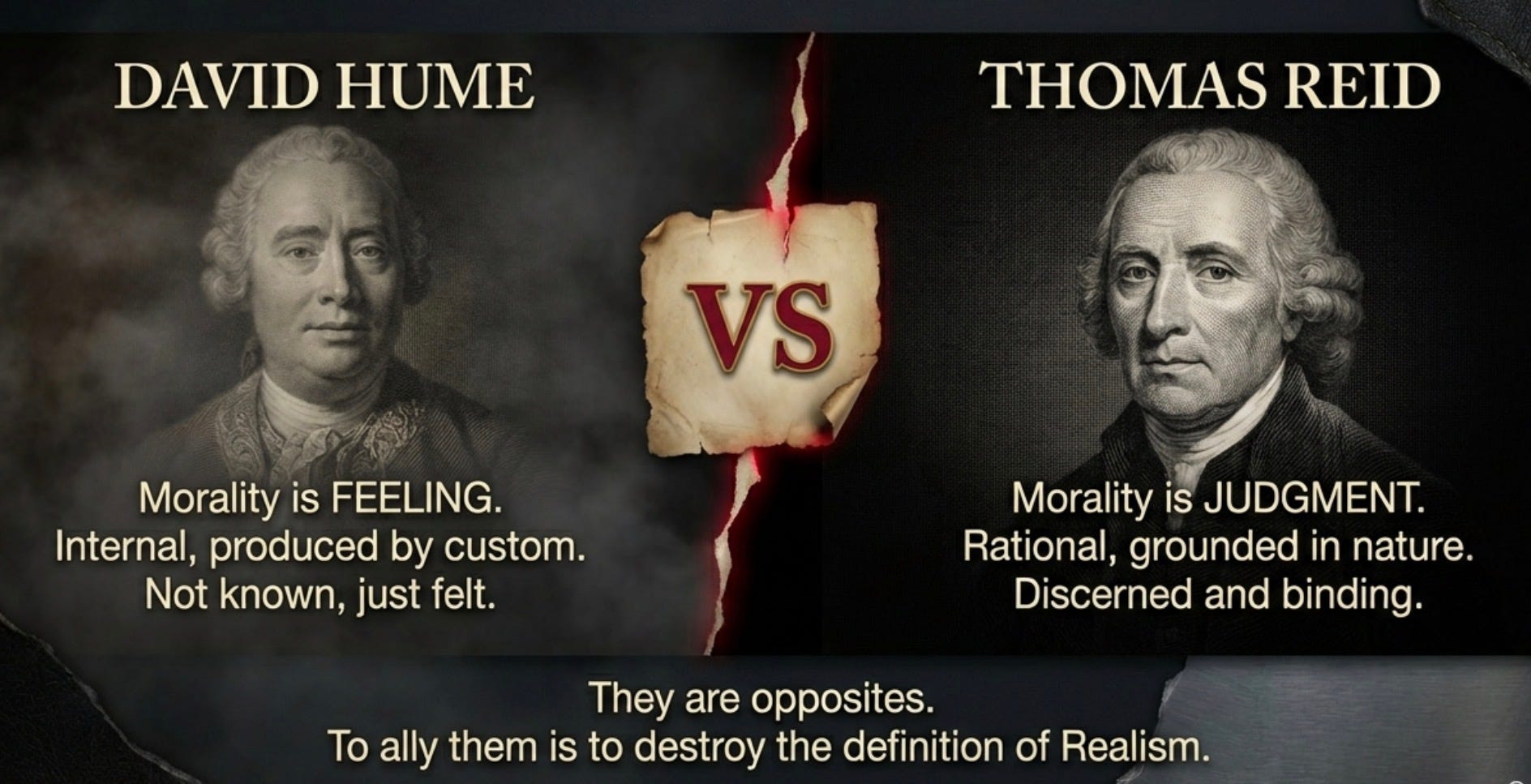
The core figures of Scottish Common Sense Realism; Thomas Reid, James Oswald, James Beattie, Dugald Stewart, George Campbell, and Founder James Wilson, worked in the Field of the cognitive faculty of moral perception - not psychological sentiment. For these thinkers, moral perception and agency was a truth-apt act of the intellect and conscience that recognized objective features of reality. It was a judgment of reason, analogous to (but not the same as) sense perception, discerning properties inherent in the action itself - not a report of ‘an inner sensation’.
Psychological (The Humean Distortion)
Descending from David Hume, the modern view reduces sentiment to subjective affect; internal feelings produced by ‘custom and association’. In this framework, moral distinctions are merely expressions of approval or disapproval - entirely severed from truth. The modern academic sleight of hand consists of reclassifying Thomas Reid’s cognitive realism as ‘proto-emotivism’ or ‘intuitionism’. By pretending that any non-inferential knowledge must be psychological rather than rational, critics rule out realism in advance. This reclassification erases the first principles of practical reason, replacing self-evident truths with ‘cultural conditioning’. I hope you can discern exactly how the deconstruction ideologues ran with the ball on that and the precise tactical use of that ideal laundering to hollow out and destroy Western Civics and the Western Canon. When objective principles are thus erased from the statutory language of education, they are replaced by the unchecked dictates of unaccountable power. That is how you had your ideological conquest of the academy and education at scale, thereby all the organs of state apparatus and corporate organizational culture.
C.S. Lewis and the Diagnostic of the Abolition of Man
In The Abolition of Man and The Poison of Subjectivism, C.S. Lewis diagnosed the catastrophic cultural transition he termed the ‘un-christening of Europe’. Lewis’s work was an urgent attempt to salvage Western civilization by defending the natural law tradition against the encroachment of Power philosophies. Lewis’s primary directive was the education of conscience and agency, with attention to the role of the emotions in that. He argued that emotions are not generators of value but must be trained to conform to objective reality.
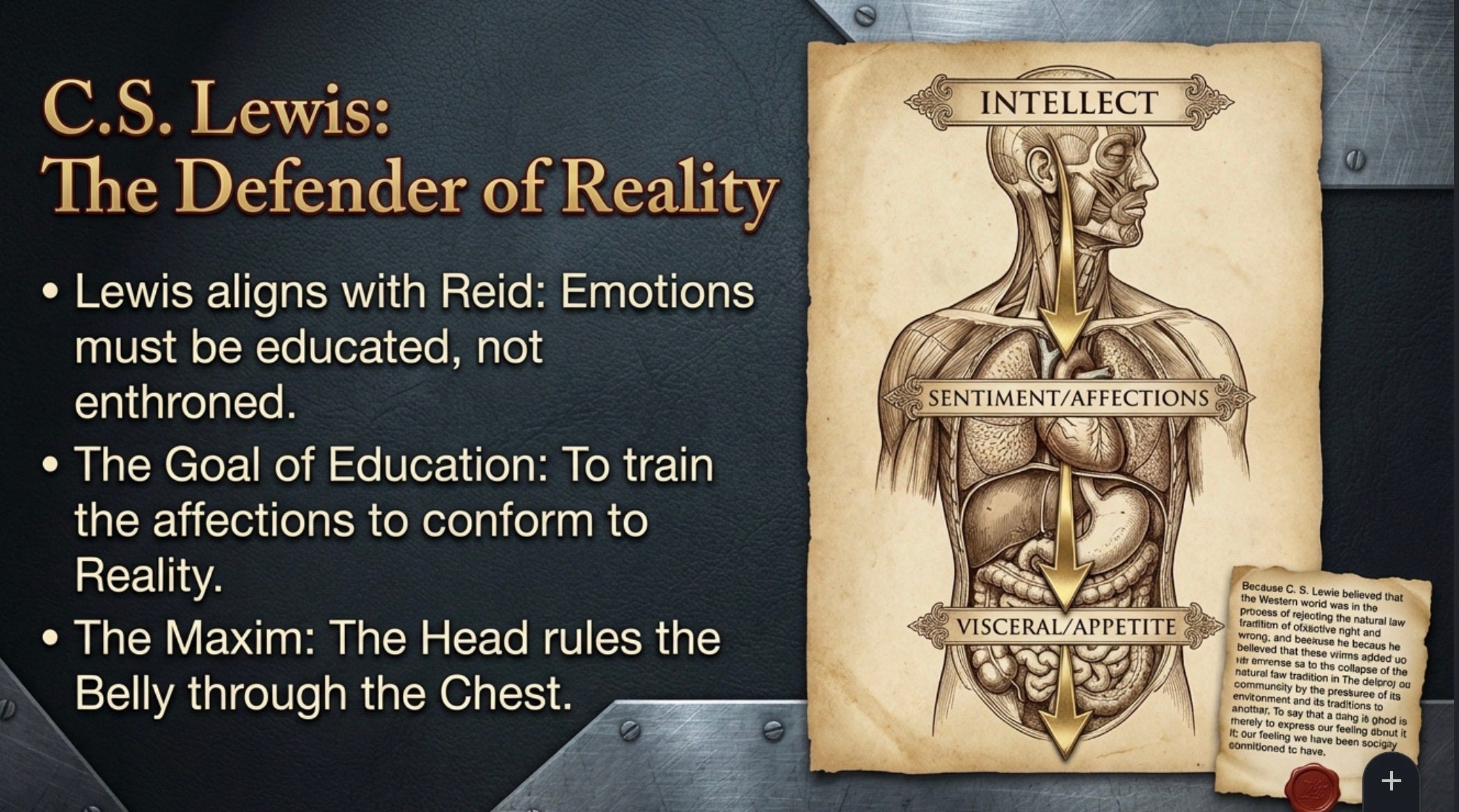
In his view, the task of the educator is to bring the student’s awareness and emotions into obedience to what is, rather than enthralling them to the ‘élan’ (as Dewey called it) the ‘what might be’ of ideological planners. He warned that the denial of objective value removes the ordinary checks to evil and that subjectivism provides the ‘golden opportunity’ for totalitarianism. If principles do not bind the conscience, then raw power must fill the vacuum. This transition facilitates the rise of Technocracy, where the individual is no longer a human being, person with individual agency to be upheld, but a post human resource to be redesigned by the ‘conditioners’.

Systemic Consequences
Technocracy, Managerialism and the Post-Human Shift
The rotten fruits of subjectivism are now visible in the dissolution of the rule of law and the rise of managerial elitism. We currently occupy an environment where technocratic administration flourishes precisely because objective truth has been rendered inadmissible in the halls of governance.
Systemic Outcomes of Subjectivism
The transformation of law into ‘plastic procedure’
Law no longer seeks to reflect immutable natural principles but becomes a flexible tool for bureaucratic utility, as evidenced by the Neufield Human Rights Tribunal in British Columbia, where subjective ‘narrative’ overrides objective reality.
The reduction of rights to ‘revocable permissions’
Without an objective foundation in being, rights are merely temporary grants from the state, subject to the expertise or ‘safety’ requirements of the planners.
The emergence of ‘unaccountable power’ cloaked in expertise
Authority answers only to itself, dismissing any appeal to truth as a mere ‘preference’ or ‘group identity conflict’.
This metaphysical inversion directly facilitates the shift toward transhumanism and post-humanism. When the definition of ‘man’ is no longer anchored in an objective ontological reality, the human person becomes a ‘negotiable’ obstacle to be managed or a ‘resource’ to be redesigned. Subjectivism clears the ground for total control by dissolving all standards higher than the administrative procedure itself.
Restoring the Cornerstone of Pedagogy for Liberty
The recovery of Common Sense Realism is the prerequisite for restoring the Corner Stone of educational pedagogy for liberty in a constitutional republic (and beyond). To reverse the current drift toward technocratic domination, we must re-establish the link between the human intellect and the objective moral order.
Policy Recommendations for Teacher Training Programs
Remove Social-Emotional Learning (SEL) Frameworks
Systematically purge teacher training curricula of non-cognitive, behaviourist-based affective management techniques that prioritize student ‘attitudes’ over the rational apprehension of facts.
Revise Teacher Certification Standards
Restore the requirement for foundational training in Classical and Scottish Common Sense Realism, ensuring educators understand moral judgment as the truth-apt act of reason.
Restore First Principles
Re-integrate the ‘first principles of practical reason’ into the statutory language of curriculum standards, affirming that self-evident truths are known directly because reality presents itself as such.
Human freedom is inextricably linked to the existence of objective reality that binds both the ruler and the ruled. Where principles are denied in theory, domination follows in practice. Only by reclaiming the shared rational apprehension of reality can we safeguard the individual against the ‘conditioners’ and preserve the foundations of a free society.


