
The Model Trap
How Realism Is Politely Reframed Out of Public Debate

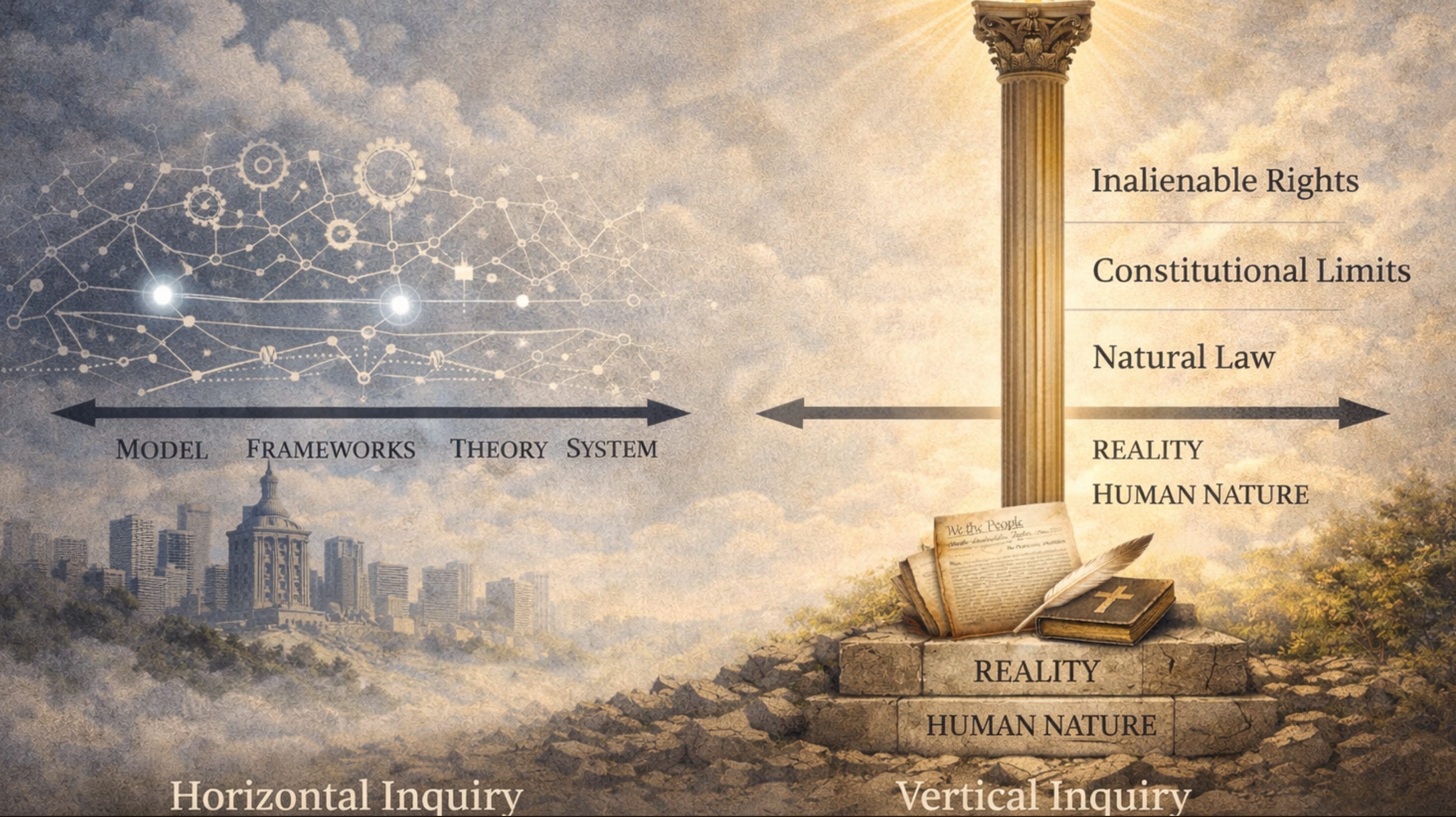
Modern ‘discourse’ moves horizontally across theories and systems. The American Founding begins vertically; with reality, the natural law and essential created human nature from which inalienable rights arise. The Declaration of Independence does not present a ‘model’ of governance; it recognizes a reality about the human person from which the limits of power necessarily follow. The American Founding was not built on a theory of systems, but on the recognition of that ontological reality from which rights arise. Before debating ‘models’, ask what ontology of the human person those models presuppose.
The ‘Virtue’ That Was Debilitating & Self Censoring
For years I accepted the dominant presumption (throughout my lifetime) that intellectual maturity meant the ability to move fluidly between theoretical frameworks. I had been trained to treat models as interchangeable tools and to explore ideas within whatever conceptual system was placed on the table. When someone introduced a new framework (scientific, philosophical, or methodological) the respectable response was to enter it and debate within its terms. This habit was praised as intellectual openness. It was presented as a virtue. Only much later did I realize that this training carried a hidden cost. Each time I stepped into a new framework in order to debate within it, the deeper question quietly disappeared: what view of reality does this framework presuppose?
The discussion moved forward, but the ground beneath it had shifted, seismically so. What appeared to be an open exchange of ideas was often something else entirely. The conversation had moved away from the question of reality itself and into a debate about competing models of description. Once that shift occurs, the original issue is no longer being discussed.
The Horizontal Training of Modern Education
Modern education conditions students to operate almost entirely on a horizontal intellectual axis. The questions encouraged within this training sound like this:
Which model explains the phenomenon most effectively?
Which framework organizes the data best?
Which theory produces the strongest predictions?
These are epistemological and methodological questions. They concern how we describe and analyze phenomena. But something important disappears when discourse remains confined to this horizontal plane. The reality of what our essential human nature actually is. Within this mode of inquiry, frameworks become interchangeable tools. Intellectual skill is measured by the ability to move from one model to another without committing oneself to any underlying ontology. Students learn to navigate theories with impressive technical fluency. Yet they are rarely asked the deeper question that determines whether those theories make sense in the first place. What ontology does this framework presuppose? Once that question is asked, many model debates collapse very quickly.
The Vertical Question
The moment someone asks about ontology, the terrain of inquiry changes. Instead of moving horizontally across frameworks, the investigation moves vertically toward foundations. The question is no longer which explanatory model works best. The question becomes:
What must reality be like for any of these explanations to make sense at all?
For those trained entirely within horizontal discourse, this move often feels illegitimate. It appears as though the conversation has suddenly abandoned the accepted rules of intellectual engagement. In reality, the inquiry has simply moved to the level where the assumptions of those rules can finally be examined. Once the vertical question is visible, endless debates about models begin to clarify. Frameworks that once appeared to compete on equal footing suddenly reveal the incompatible metaphysical commitments they silently rely upon.
Why This Matters for Constitutional Government
This distinction between horizontal and vertical inquiry is not merely philosophical. It has profound civic consequences. The American founding presupposes a particular ontology of the human person and the moral order. The language of inalienable rights only makes sense if certain things are true.
It presupposes that human beings possess essential created nature.
It presupposes that moral truths are intelligible.
It presupposes that political authority is limited by realities that precede the state.
These premises belong to the domain of metaphysical realism. If discourse remains confined to the horizontal plane of models, systems and frameworks, those ontological premises are never examined. Rights gradually cease to be grounded in reality itself and transition to constructs within administrative systems. Once that happens, the language of rights can (rhetorically) remain in place while the (substantive) reality that originally gave that language meaning disappears. The operational consequences for Constitutional Republican Governance should be clear here. As Justice Clarence Thomas stated; “words mean things”.
The Discursive Pivot
In public debate this transition from the vertical to the horizontal often happens politely. A discussion that begins with questions about human nature or moral reality gradually moves toward scientific models, systems theory, or explanatory frameworks. Participants are encouraged to reconcile their position with these models rather than examine the ontological assumptions underlying them. The move is subtle, but its effect is decisive. Realism ceases to be the ground of the discussion. It becomes merely one interpretation among many competing frameworks. The original question about reality itself has already been displaced.
Holding the Ontological Line
Once this pattern becomes visible (recognizable), it is possible to respond differently. Instead of entering every new framework that appears in the conversation, one can simply ask the question that modern discourse has been trained to avoid:
What ontology does this framework presuppose?
This question does not reject science or analysis. It simply restores the order of inquiry from the horizontal to the vertical. Reality comes first - frameworks come later. This was always why Metaphysics preceded Science - structurally - and when that order is restored, debates that once seemed endlessly complex (and frequently circulatory!) often become remarkably clear. And the foundations upon which constitutional liberty depends finally come back into view.
Horizontal axis:
movement across models, frameworks and theories.
Vertical axis:
movement toward ontological foundations - the nature of reality itself.
Modern education trains students almost entirely to operate on the horizontal axis. Intellectual skill becomes the ability to move fluidly between models and explanatory frameworks. But the deeper philosophical question lies on the vertical axis:
What must reality be like for any of these frameworks to make sense?
Why This Matters
The American founding rests on premises that belong unmistakably to the vertical axis. The Declaration of Independence does not present a model or framework. It upholds and defends ontological understanding about the reality of created human nature:
Human beings possess created nature.
Rights arise from that nature.
Political authority is therefore limited by realities that precede the state.
Those premises cannot be evaluated within a horizontal debate about models or systems. They are predicated on the understanding and recognition that reality itself possesses intelligible structure. When discourse remains confined to the horizontal plane of models and frameworks, those ontological premises disappear from view. Rights then are misapprehended as constructs within administrative systems rather than recognitions of what is real. That is why the ability to move vertically (to ask the ontological question) is not merely a philosophical exercise. It is a fundamental civic necessity.
The Moment the Ground Disappears
This removal of the vertical axis rarely happens through open confrontation. In most conversations it occurs politely. A discussion begins on ontological ground. Someone raises questions about the nature of human beings, the source of rights, or the moral limits of political authority. These are questions about reality itself. Then a subtle pivot occurs. A participant introduces a model, framework, or scientific perspective. Perhaps it is a theory of complex systems, an evolutionary account of social behavior, or a systems model used in policy design. The tone remains cordial and curious. The suggestion is often framed as an invitation:
How does your position fit within this framework?
Can realism accommodate this model?
How would your view interpret these emergent phenomena?
At first glance the questions appear reasonable. Yet something important has already happened. The discussion has moved from ontology to models. Once that move occurs, ontological realism is no longer the ground of the conversation. It becomes one framework, an interpretation among several competing frameworks. Participants begin comparing explanatory models rather than comprehending the reality of created human nature itself. The original question has disappeared. What began as an inquiry into the nature of human beings and the foundations of rights has (imperceptibly to so many) become a debate about how different theories interpret complex systems. Most participants do not notice the shift because modern education has trained them to treat this move as intellectually responsible and sophisticated.
‘Theories are the creatures of men which nature seldom mimics’ (Thomas Reid)
Entering the new framework and debating within its terms is seen as the proper scholarly response. Yet the consequences of this tactical move are profound. If the conversation remains confined to models and systems, the ontological premises that originally grounded the discussion are never examined. Rights, human dignity and constitutional limits on power are misunderstood as negotiable constructs within administrative frameworks rather than recognitions of non-negotiable real nature. The ground has disappeared, even as the conversation continues. Discourse Theory itself has a long history of being deployed for this very tactical of dissolution and subversion and for in depth analysis on that please see the work of Stephen Coughlin here:
https://unconstrainedanalytics.org/?s=Discourse+Theory
Recognizing this moment (the moment when ontology is replaced by models) is the first step in escaping the snare. When the pivot occurs, the most important response is not to debate the model. It is simply to ask the question modern discourse has been trained to avoid:
What ontology does this framework presuppose?
Why the Founding Documents Cannot Be Debated as Models
The American founding documents do not present a theory or an analytical framework. They do not offer a model for managing complex systems or optimizing social outcomes. They state non-negotiable premises about the reality of created human nature. The Declaration of Independence begins with the assertion that certain truths are self-evident. Human beings are created equal. They are endowed with rights that are not granted by governments and cannot be legitimately taken away by them. Governments exist for a limited purpose; to secure those rights. These are not methodological claims. They are ontological premises. Without those premises, the language of inalienable rights loses its meaning. If rights do not arise from the nature of the human person, they must arise from somewhere else. In modern administrative societies, the answer becomes increasingly clear; they arise from institutions that claim the authority to define and regulate them. What were once understood as rights grounded in reality begin to appear as permissions granted within evolving systems of governance. While this may be true for nations governed under the principle of Parliamentary Supremacy, it is not true for the American Constitutional Republic.
This is why the discursive shift from ontology to models is not a neutral intellectual move. When discussions about human nature, law and political authority are reframed as debates about systems models or explanatory frameworks, the ontological premises of the founding are tactically set aside - in the presumption that modern educated intellectuals and laymen will fail to notice and fail to discern the grave consequences in practise. The language of rights can (rhetorically) remain in place while the reality that once grounded that language disappears - is hollowed out - and this has been a long operation of pedagogical subversion in our institutions of learning, to bring us to this state of cognitive dissonance, or as Yuri Bezmenov described it - Demoralization. To recover the foundations of constitutional government requires restoring the order of inquiry that modern discourse so often reverses. The American founding rests on the recognition that political authority operates within a reality it does not create/construct. When that recognition is lost, constitutional limits on power gradually dissolve into administrative management. Restoring the ontological ground of the conversation is therefore not merely a philosophical exercise. It is a civic responsibility and the duty of all citizens to understand and to embody in their actions with what they uphold and what they defend.
Holding the Line
Modern discourse (and the endless Media Dialogos content, Public Debate spectacle….etc.) often trains us to believe that intellectual seriousness requires entering every framework that appears in the conversation. When a new model is introduced, we feel obliged to explore it, reconcile with it, or debate within its terms. The habit appears generous and open-minded. It satisfies the appetite and aspiration for ‘Sense-Making’ and consensus engagement. Yet it politely concedes that which is essential; the ground of reality itself. Once the discussion moves entirely among models, the deeper question disappears. Recovering the vertical dimension of inquiry changes the terrain immediately. The question becomes simpler and more fundamental:
What must reality be like for any of these frameworks to make sense at all?
When that question is asked, the endless proliferation of models begins to lose its power to disorient. The inquiry returns to the nature of things themselves. This is not a rejection of science or analytical tools. Models and frameworks can illuminate aspects of reality. But they cannot replace the ontological ground upon which they are predicated. When that order is reversed, rationalizations begin to substitute for truth. The American founding was established by men who understood that political liberty depends upon recognizing realities that government does not create. The language of inalienable rights presupposes a world in which human beings possess essential nature and moral truths are intelligible. Holding that line in public discourse does not require hostility or accusation. It requires only a simple discipline; refusing to surrender the question of reality itself. When the conversation begins to drift into frameworks and models, the response can remain calm and direct.
What ontology does this framework presuppose?
That question restores the order of inquiry. And once the order of inquiry is restored, the foundations of liberty finally come back into view: