
The Foundations of Clear Thinking
From Reality to Understanding

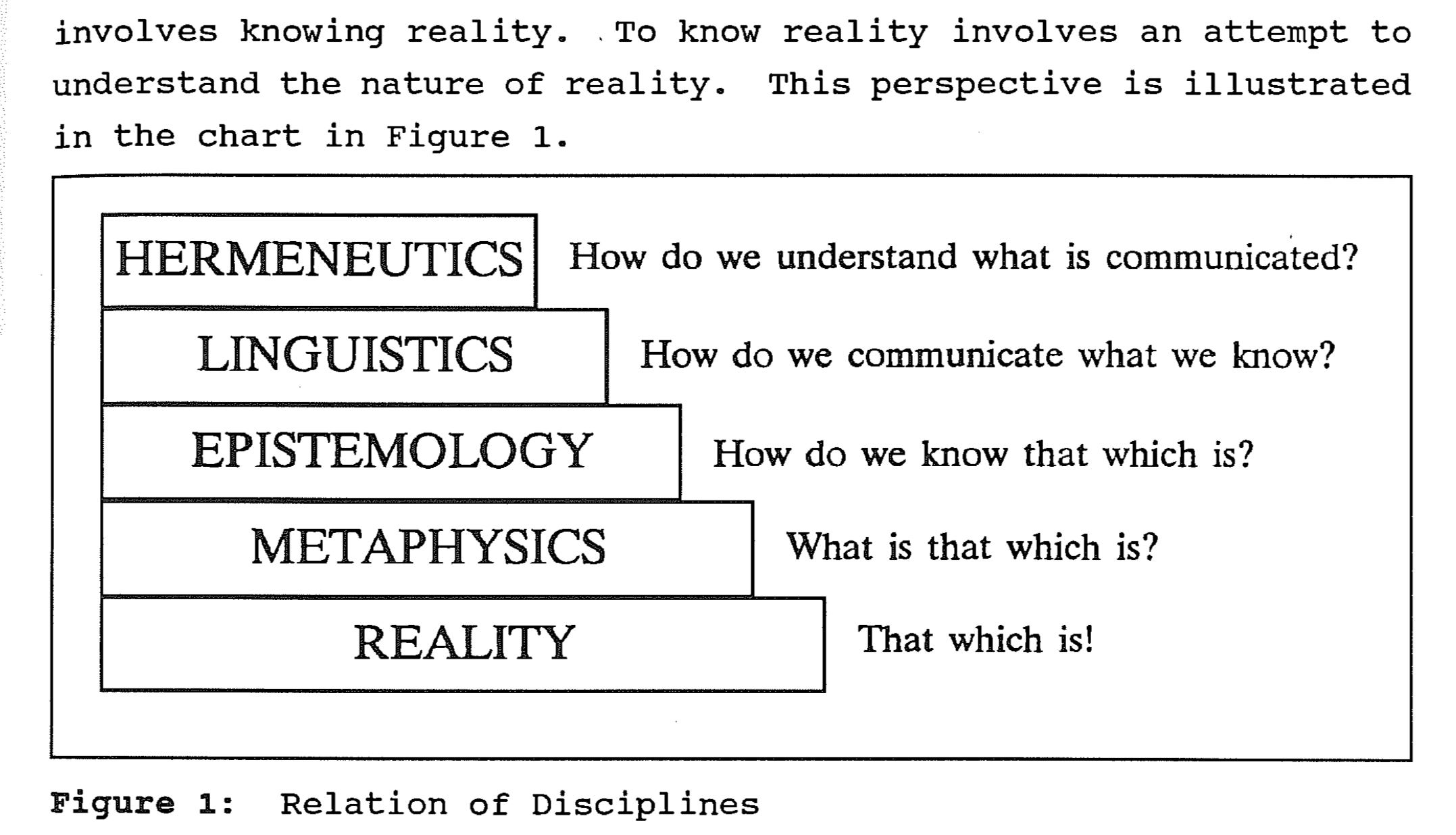
Thomas A Howe’s foundational sequence from his thesis found here: https://digitalcommons.liberty.edu/cgi/viewcontent.cgi?article=1035&context=masters shows that interpretation rests on a prior chain of realities; being, knowledge, language and communication. For structural cohesion, each layer depends on the integrity of the one beneath it. As with any structure and its foundations. If reality is denied, metaphysics has no object; if metaphysics collapses, knowledge loses its anchor. If knowledge becomes unstable, language loses its referent and when language loses its grounding, hermeneutics becomes incoherent. Here at one simple glance is the structural blueprint of precisely what Howe is articulating throughout his work. Meaning is possible only when each level remains accountable to what is real.
Thomas A. Howe’s The Nature of Meaning is not just a thesis about how to read the Bible. It is a step-by-step account of how reality, thinking, language and interpretation fit together. At each stage, Howe is asking what must be true about the world, the mind and about words, for intelligible communication and honest interpretation to be possible at all. That same structure is what a constitutional republic quietly relies on; real human nature, real truth (not my truth), stable meanings and interpretations that answer to the text rather than to the interpreter’s desire and will.
In his introduction, Howe shows that most fights over ‘what the text means’ are not really about the text. They are about hidden/unexamined assumptions concerning how thought, language and reality are related. He points out that an interpreter’s philosophy of ‘thought and word’ shapes their entire approach to reading. Two people can look at the same sentence and mean something completely different by the very worms ‘meaning’ and ‘truth’. You’ve seen this ‘talking past’ one another and the resulting impasse between people in exchanges on social media and tv/podcast debates day in, day out. These exchanges are worse than fruitless because they demoralize viewers/listeners/readers, leaving them with the assumption that there is no truth and only the voice with the most popularity, esteem, prestige, charisma and power counts in the public square at all. These media debates and exchanges reject the anchor of reality, its intelligibility and the means by which we as rational beings recognize and discern that. In their very format, these well funded, promoted exchanges are not simply disagreeing over specific passages of text, events or public statements, they are operating with different underlying presumptions of how reality and language function in relation to one another (see our structural blueprint at the top).
This understanding of intelligibility, comprehension and articulation is not limited to theology. The same thing happens within education (including academia - which has poisoned the well), governance and law, what I group together as; civic infrastructure. When people no longer share a basic understanding of what truth is and how words are purposed to convey reality (not to confound it) sophist manipulation of words is the tool for interpretation destabilizing, with the resulting civic fallout; demoralization (inability to discern reality, even when it is fully presented to you).
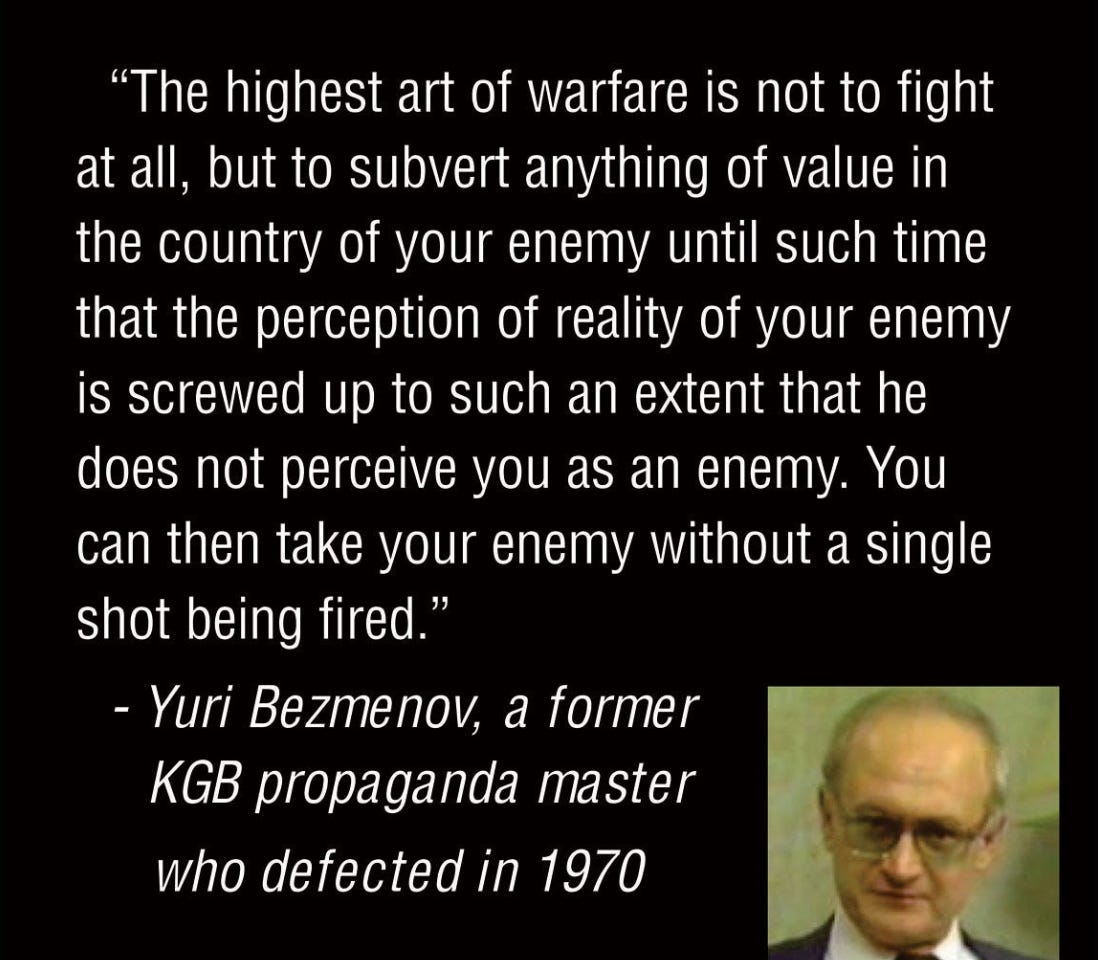
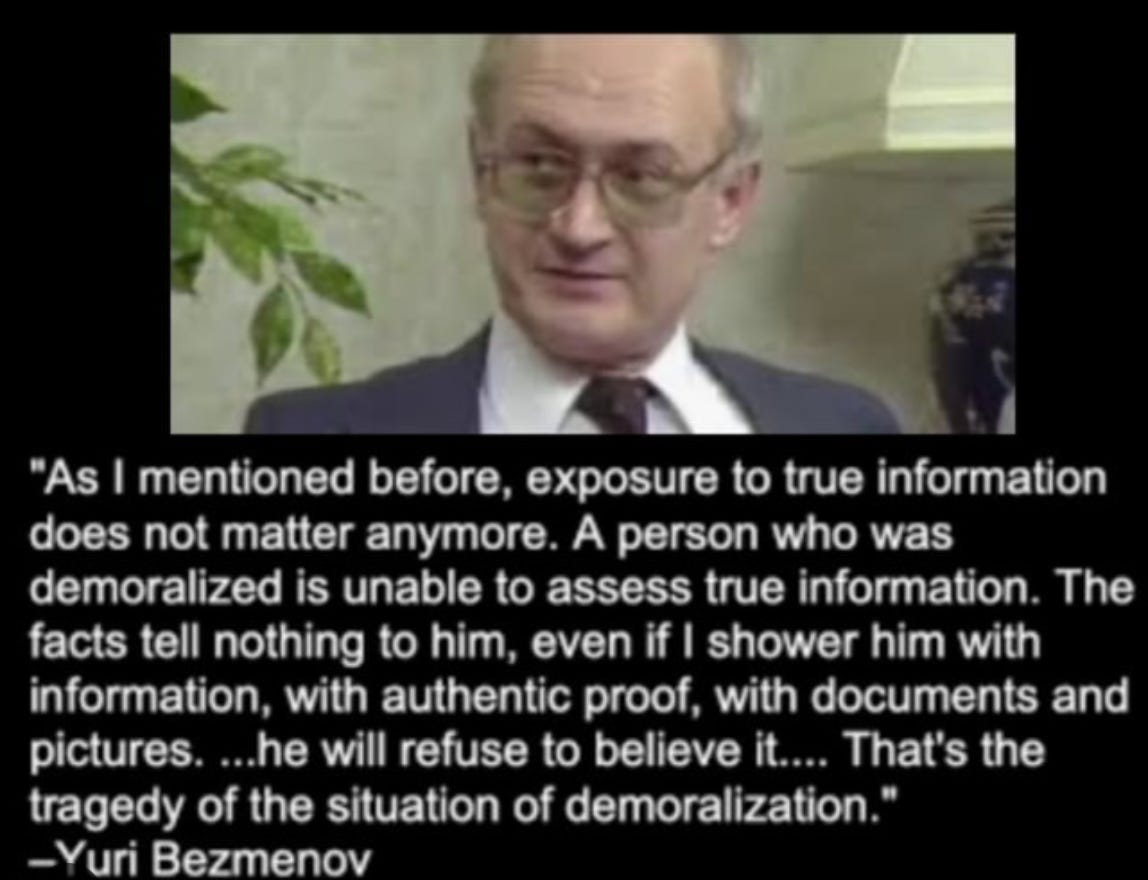
I couldn’t simply stop at the investigation of the roots of subversion. I could (and many do) provide content all day everyday on the techniques of psychological warfare, but you can go on consuming that for ever and still not have learned and understood how to orient in reality yourself and how to navigate deception. You still would not recognize and discern the foundations upon which to stand - what ‘health’ looks like and how that functions, when not poisoned by pathological philosophical (sophist) premises. I had to get to grips with the necessary foundations and now I understand much more why they were deliberately removed from education and down through various historical eras, derided, negated and rejected. They do not serve power. They serve discernment, defence and vigilance.
A society cannot be repaired until we return to the point where reality stopped being treated as intelligible.
C. S. Lewis expressed the same principle with perfect clarity:
“If you are on the wrong road, progress means doing an about-turn and walking back to the right road.” (Mere Christianity, Book 1, Chapter 5)
Lewis’s argument is that true correction is impossible until one first traces the error back to its point of origin. Moving forward while the foundational inversion remains unaddressed only deepens the damage.
Overview
Starting with Howe’s introduction, let’s see how he identifies this as the real civic fault line.
Chapter 1 - The Chain from Reality to Interpretation
Howe sketches a simple but decisive sequence:
Reality - Metaphysics - Knowledge -Language -Interpretation
Interpretation sits at the end of a chain, it is not free-floating. If the earlier links are damaged, the later ones fail. He distinguishes between:
order of being - what exists and what it is like
order of knowing - how we come to understand it
The order of being comes first. The mind and language respond to what is there; they do not create it out of nothing. For civic life, this means that if the shared sense of reality erodes, public reason erodes. Once public reason erodes, legal and constitutional language becomes plastic; once language is plastic, the protections written into law can be redefined away. Howe’s 1st Chapter establishes that entire chain.
Chapter 2 - What Kind of World Are We Talking About?
Here Howe deals with different views of reality:
Views that say the world is basically ‘inside the mind’, that deny real shared natures (e.g. given created human nature as something fixed) and that treat general terms as mere labels; nomen not natura, from which nominalism operated. This might sound abstract and irrelevant to basic everyday life, but when you’re faced with defending students and children from the predatory jaws of the Education-Industrial-Medical complex deploying deconstruction of given, sexed human nature for corporate profit and the negation of inalienable rights - there is nothing abstract about that. This is basic civic defence against the dark arts 101 and what you need to hold the line on is Metaphysical, Ontological Realism, which states clearly the recognition, understanding and acknowledgement that things (including humans) have real natures and that our general linguistic terms answer to those real natures.
Howe shows that if you deny real shared natures, then general terms can no longer carry stable content. Words become negotiable slogans rather than references to something that actually exists in the nature of things. His conclusion is that realism is not an academic luxury or a ‘conservative taste’, it is the minimum requirement for any serious claim about rights, duties, laws, or persons to be more than rhetoric. It is common sense, not because ‘all people like/want it’, but because it is common to all given, created human nature - whether people like or want it. It is non negotiable and as people eventually discover, arguing with reality is not common sense. The destruction is fatal at the individual and the societal levels. A society that willingly abandons its shared common sense can only fracture, polarize, dissolve and destroy itself - requiring powerful authoritarian control to ‘keep the peace’. The metaphysics of realism is what makes shared intelligibility and common sense possible at scale at all. This is why our institutions of learning removed it. Operationalized as they were, as arms of statecraft.
Chapter 3 - How the Mind Knows Reality
In Chapter 3, Howe turns to knowledge. If realism is true, how does the mind actually connect to what is real? He clearly articulates that the mind is structured to receive the form or intelligible content of things. Knowing is not inventing reality; it is recognizing what is already there. The basic direction is from being to knowing, not the other way around. He contrasts this with theories posited of the mind ‘supplying’ ‘categories’ that shape reality from the inside, or where truth is reduced to whatever is practically useful or socially accepted. Those moves cut the mind loose from reality and turn knowledge into instrumentality; construction, strategy, or convenience.
For law and civic argument, Howe’s observation is straightforward; if truth is just what a group decides is useful, then legal and political reasoning becomes a competition of vying interests, not an appeal to what is right in itself. A republic that depends on citizens using reason to seek truth cannot survive under that model.
Chapter 4 - How Words Signify
Chapter 4 applies this to language. Howe asks; if the world is real and knowable, how do words pick out things in that world? He criticizes theories that treat language as purely conventional; where words have whatever meaning a community happens to assign to them and nothing more. This is precisely what C.S. Lewis was criticizing in his essay ‘The Poison of Subjectivism’ and its resulting book; ‘The Abolition of Man’, which he dramatized in ‘That Hideous Strength’. Words work because the world is organized in a way that can be understood and named, pointing to a real kind of thing in the world, with a definite nature. If that anchoring in reality is denied, then meaning becomes entirely dependent on shifting fashion or power.
‘Being & Naming’ - Civic Consequences

Dr. Larry Arnn’s reflection that ‘if we can call them by their names, they have being and the beings of the good things are figments of God’ directly references Exodus 3:14 and Acts 17:28, signifying the Creator’s gift of Being; the foundation of all that is real. Adam’s act of naming embodies humanity’s vocation to recognize and speak truthfully about …
Here the legal implications are sharp; if words in a constitution or statute have no stable connection to the realities they name, then their content can be re-assigned by those who control ‘interpretation’. Language becomes a tool of control rather than a vehicle of truth, as Joseph Pieper set out in his ‘Abuse of Language; Abuse of Power’.
Chapter 5 - Interpretation Under Pressure
Having laid down reality, knowledge and language, Howe now turns to interpretation itself. He traces how various modern approaches quietly shift the centre of gravity from the author and the realities being described, to the consciousness of the reader or the ‘community of interpretation’. Once that shift occurs, the text no longer corrects the reader’s understanding; the reader (or the community) consumes and reshapes the text. Howe shows that this move is not neutral. It depends on earlier denials that truth corresponds to reality or that minds receive rather than construct and the denial that words answer to real natures. Once those are given up, it ‘feels’ natural to say, ‘meaning is what the text does for me’ rather than, ‘meaning is what the author said about reality’. For civic life, this is exactly the fault line between interpretations that are disciplined by the text (original meaning, authorial intent, textual constraints) and interpretations that treat texts as raw material for present projects, negating original textual meaning and author intent. Howe’s point is that this is not just a ‘method choice’ - it is the outcome of a whole metaphysical and epistemological shift.
It needs to be acknowledged here that the weaponization of Methodological Approaches in higher education was tactically purposed for exactly this. Destruction of canons of knowledge and the means by which to understand and articulate them - participatory knowledge and functional literacy, across domains. Ideology is not an end in itself. It has been a strategic tool of Epistemological Warfare on domestic population. Remember that John Dewey played a crucial pedagogical role in removing metaphysics from education. How many people are aware of John Dewey’s lectures given in China (on the subject of Bertrand Russell’s ‘Social Democracy’) and Mao’s appreciation for them? How many people understand the relationship between Mao’s strategic destruction of the ‘Four Olds’ and Dewey’s embracing of the Four Moderns? Wasn’t Mao trained on the Yale In China program?
Read through the resources in my pinned tweet (Renault’s essay on Mao & Dewey; Pragmatic Affiliations is the 3rd resource down in that Thread of threads:
https://x.com/thepalmerworm/status/1811570746491093438?s=61
Chapter 6 - Concrete Hermeneutical Consequences
In Chapter 6, Howe shows how these different philosophies play out in actual biblical interpretation. He compares readings that assume realism with readings that assume more subjectivist or constructivist approaches. This has much to teach us in civic application too. The important move is diagnostic; he shows that many disputes in interpretation are really clashes between underlying philosophies, not mere differences in technique. Two interpreters can follow similar procedures, but if one believes that texts report reality and the other believes texts mainly construct communities, they will not arrive at the same place. This diagnostic move can be carried over directly into public life. Political, legal and cultural arguments often talk past one another because participants are working from incompatible assumptions about reality, truth and meaning. Without exposing those assumptions, argument becomes endless and unproductive, which is why I refuse invitations to ‘Debate Me Bro’ and even if I was set up for doing podcasts, I’d refuse the vast majority who operate in this unproductive way. Sure it’s financially productive for them; clicks, likes, subscriptions - but ultimately still confined within subjectivist conflict churn and catering to consumer appeal; the business model of The Marketplace.
Chapter 7 - The Closing Argument
Howe’s final chapter restates his core thesis that meaning rests on being. If the order of being is denied or blurred, the entire chain; knowledge, language, interpretation - becomes unstable. He emphasizes that many theological disputes are really philosophical ones in disguise. The same is true for civic disputes. People argue over policy, precedent, or ‘what the Founders meant’ while quietly relying on clashing views of human nature, truth and language. The closing implication is sober for civic infrastucture. Without a return to a realist understanding of reality, knowledge and meaning - no interpretive discipline; whether theology, law, or constitutional governance, can remain coherent over time. The system will keep working only as long as enough people still, often without saying so, presuppose realism. Post truth presumption is the acid of Solve et Coagula.
Howe’s Architecture in Civic Terms
If we put all the chapters together, we have an architecture:
Realism about reality (duh!) – there is a real human nature and a real moral order
Confidence in knowledge – minds can truly know that order
Anchored language – words connect to real natures, not just to group consensus
Bound interpretation – reading is responsible to what the text actually says about reality
This is exactly the kind of architecture that the American Founders quietly assumed when they spoke about self-evident truths and unalienable rights. Howe’s thesis rebuilds that architecture from the ground up. It is not confessional, it is ontological and metaphysical. It is a forensic reconstruction of the conditions under which intelligibility, meaning, education, law, and self-government remain possible. Howe’s thesis was among the first in depth investigations into philosophy and metaphysics that I had to undertake in order to fully understand the causal roots of the ideological subversion in education that I’d faced. It healed the cognitive paralysis I’d been under for so many years and in my opinion, would help so many people across professions if the clarity it articulates formed the cornerstone of Education and the requisite foundation of civic professional accreditation across all domains.