
The Anthropological Line
How the Redefinition of Man Subverts Jurisprudence Itself

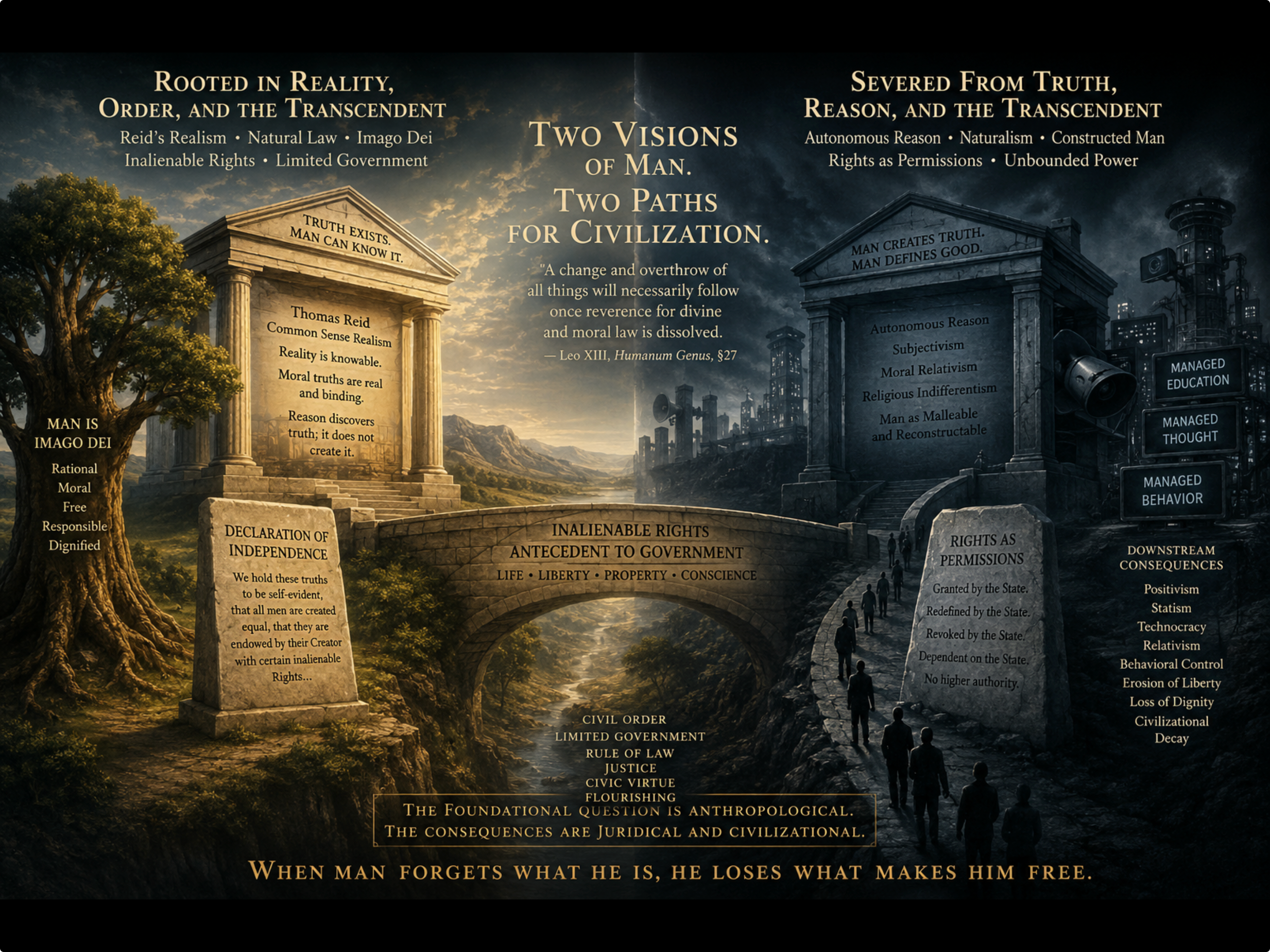
When a civilization no longer understands what man is, it cannot preserve the liberties ordered to his nature. Thomas Reid’s realism, Founding Father Justice James Wilson’s constitutional philosophy and the Declaration’s doctrine of inalienable rights all presupposed that man is not a construct of the state, the collective, or autonomous will ~ but that man is a rational and moral being created within a transcendent order. Once that ontological foundation is severed, rights cease to be inalienable and become administratively granted permissions. Law becomes policy and Education mere conditioning. Governance changes from protecting liberty under moral law to managing populations through institutional power. The crisis is therefore not merely political or theological. It is anthropological. The downstream consequences are juridical, constitutional and ultimately civilizational. Man no longer defined as a human being, but a transhuman and post human ‘planetary resource’ for deconstructive commodification and tokenization under technocratic digital systems management.
Pope Leo XIII’s warning in the 1884 encyclical Humanum Genus was not principally directed against the claim that man can know objective moral truths through reason (recta ratio). Rather, it was directed against the progressive severance of reason (the ‘Theory of Ideas’ lineage) from transcendent moral order and the elevation of autonomous human will as the source of legitimacy, morality and political authority. When Leo warned in Humanum Genus (1884 ~ §§10–12) that certain modern systems sought ‘the utter overthrow of that whole religious and political order of the world which the Christian teaching has produced’ and the substitution of a new order ‘drawn from mere naturalism’, he was describing the political and educational consequences of removing man from a binding ontological and moral structure antecedent to the state (and corporation). Leo’s concern was not that man possesses reason (endowed with reason by his Creator), but that reason had (via academic intellectual idea laundering) begun to be treated as self-authorizing and detached from any immutable order beyond human construction.
Thomas Reid’s philosophy stands in direct opposition to that severance Leo was flagging. Reid rejected the skeptical and representationalist epistemologies which had increasingly dissolved recognition and acknowledgement of objective reality after Descartes, Hume, Hobbes, Locke, Rousseau, Kant and subsequently, Hegel. In Essays on the Active Powers of Man (Edinburgh: John Bell, 1788 - Essay III, Part III), Reid argued that moral judgment is not merely preference or sentiment, but corresponds to real obligations grounded in the essential created nature of things. Human reason, in Reid’s acknowledgement (and here recognize that debt to Aristotle and Aquinas), does not manufacture truth; it apprehends reality. The human mind is constituted to know a real external world and to recognize genuine moral distinctions.
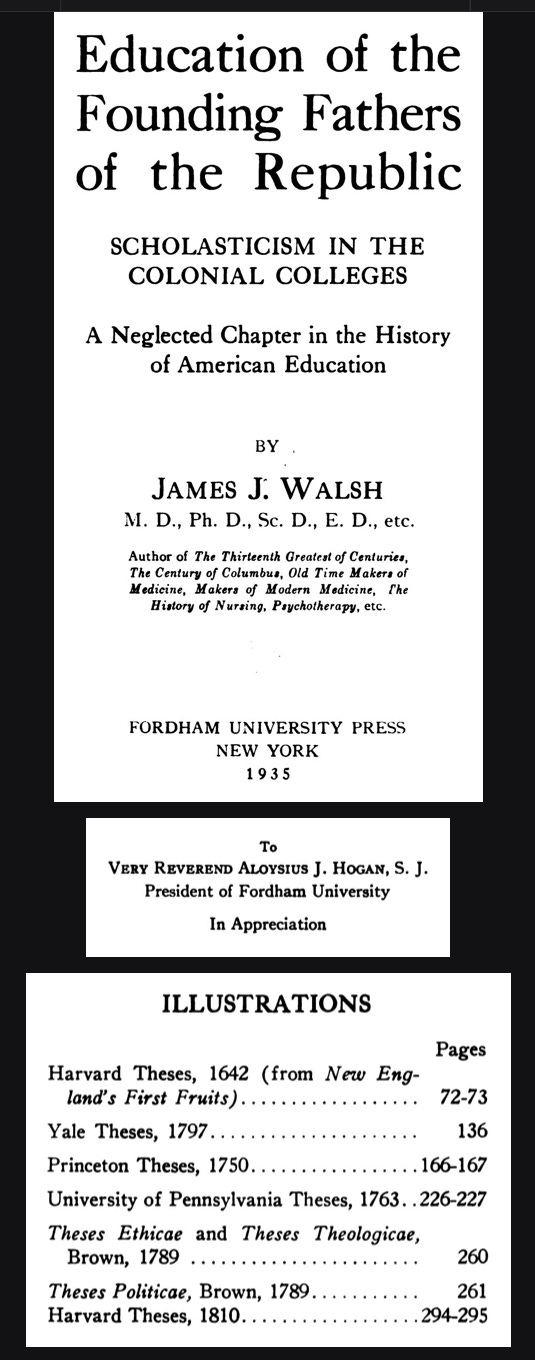
As James Walsh details, this was the scholastic education of the Founders themselves regarding the ontological understanding of man. It’s why this realist anthropology became foundational for the civic philosophy absorbed by the American founders, informing the Founding documents and governance architecture. It formed the bedrock of inalienable rights and in many respects, Thomas Reid’s realism (which is that Aristotle/Aquinas genealogy) and the Declaration of Independence’s doctrine of inalienable rights stand as barriers against precisely the kind of anthropological reconstruction Leo XIII feared. That recognition is indispensable for disentangling the modern confusion which collapses all appeals to ‘reason’ and ‘natural law’ into a single undifferentiated category. Once those distinctions disappear, the public is drawn into sterile sectarian identity warfare while the far more consequential juridical and civic question vanishes from view; what is the understanding of man which sustains a constitutional republic ordered toward liberty under law? And I would add here - why is it not taught and why has it been usurped with sophist positivism, behaviourism and ‘evolutionary theory’? Well, we know why - those are the intellectual tools of statecraft through which ideological possession could take hold for social engineering and the planned destruction from within.
Wilson’s lectures on law (over 20 years) repeatedly demonstrate that the American constitutional order was not conceived as a system grounded in state permission, collective will, or mere contractual arrangement. Rather, rights were understood as antecedent to civil government (and corporation) because they arose from the nature of man himself under the ‘Laws of Nature and of Nature’s God’. In The Declaration of Independence the colonies did not appeal to royal concession or parliamentary privilege, but to truths held to be self-evident because they reflected reality itself. Wilson later reinforced this structure in Collected Works of James Wilson (ed. Kermit L. Hall and Mark David Hall - Indianapolis: Liberty Fund, 2007, vol. 1, pp. 105–107) explicitly rejecting the voluntarist and statist tendencies found in Pufendorf and Blackstone. Civil authority was morally limited because sovereignty ultimately resided in the people under higher moral order. The juridical implication is immense; with rights arising from what man is (not what man has, says or does), government remains permanently constrained by truths it did not create and cannot legitimately redefine.
This distinction is exactly where modern teaching and media discussion so often collapses. The same sophist propagandized culture of ignorance and arrogance which now equates constitutional republicanism with autonomous Enlightenment individualism routinely fails to distinguish between realist natural law and later positivist or constructivist systems which progressively relocated authority from reality to institutional will. Reid’s Common Sense Realism and James Wilson’s constitutional theory belonged to the former category, not the latter. Their anthropology understood and acknowledged that human beings possess intelligible nature, rational agency and moral accountability within transcendent order. Remove that foundation and the downstream civic architecture changes accordingly. Rights become permissions and Law becomes policy. Citizenship becomes behavioral management and Education transitioned from formation in truth toward adaptive social conditioning (exactly the remit for over a century with the ‘Education to Workforce’ pipeline under the drive for World Federation).
Here Leo XIII’s warnings and the American realist tradition converge far more than many modern readers recognize (or these days thanks to modern miseducation, are even equipped to recognize). Leo warned in Humanum Genus that once reverence for divine and moral law is dissolved, ‘a change and overthrow of all things will necessarily follow’. James Wilson likewise warned in ‘Of the General Principles of Law and Obligation’ (Collected Works of James Wilson, vol. 1, pp. 498–500), that ‘liberty cannot survive apart from moral restraint and civic virtue rooted in objective order’. Both recognized that governance structures cannot remain stable once man himself is reconceived as a purely self-creating (ideologies) or administratively malleable (technocratic behaviourism - nudge/Game Theory/tokenization etc) being. The issue was never merely theological factionalism. The issue was anthropological jurisdiction.
This also explains one of the great historical ironies of the modern West. Founding-era Protestant realism; especially in the Scottish Common Sense tradition transmitted through John Witherspoon, Thomas Reid, and James Wilson, upheld many of the very civilizational concerns Leo XIII later articulated regarding moral order, education and the dangers of severing political authority from transcendent truth. Yet much of later Protestantism progressively failed to defend those same foundations. As theological liberalism, revivalist subjectivism, dispensational fragmentation, pragmatism and therapeutic religion spread through Protestant institutions during the nineteenth and twentieth centuries, the ontological and juridical foundations of man as imago Dei were steadily abandoned in practice. The language of ‘rights’ was retained, but increasingly detached from any stable account of what man is. Once Protestant institutions ceased defending metaphysical realism and objective moral order in the civic sphere, they possessed little resistance to the rise of positivism, behavioural psychology, managerial education systems and technocratic governance.
In many cases, churches themselves absorbed the very anthropological assumptions which dissolved the constitutional architecture they once helped sustain. Man increasingly came to be treated not as a creature possessing inherent dignity and rational agency under transcendent law, but as a psychologically conditionable, economically managed, therapeutically administered and politically reconfigurable ‘plastic’ being. As futurist and Dark Enlightenment figure Nick Land would come to coin; Techno-Plastic Beings - in other words, not ‘beings’ at all, but ‘becomings’ - clay in the hands of tyrants and tyrannical mechanisms operationalized through the organs of Education, Media, Law, Health and Governance. The failure was therefore not merely theological. It was juridical and civilizational. A constitutional republic grounded in inalienable rights cannot remain structurally intact once the anthropology which undergirds those rights is surrendered.
The modern crisis emerges precisely because later generations retained constitutional vocabulary (rhetoric) while abandoning the substantive realist metaphysics which made that vocabulary intelligible. ‘Rights’ increasingly became detached from any stable account of human nature and were reinterpreted through positivism, pragmatism, evolutionary anthropology, ideological social construction and technocratic administration. Under those conditions, the constitutional republic gradually ceases to function as a system of limited government recognizing antecedent moral realities and instead becomes an apparatus for managing populations according to shifting ideological and bureaucratic imperatives. A technocratically (scientifically) managed ‘Democracy’ - which the American Founders expressly rejected and which is now through the America 250 Anniversary initiatives, attempting to operationalize as a coup to overthrow the Constitutional Republic itself. To ‘Phoenix The Republic’ and subsume America within global international technocratically administered ‘Democracy’. America finally ‘taken back’ from its Independence and sublated to International inter-Dependence.
The current vastly funded initiatives from many organizations, influencers and public intellectuals to convince Americans to believe that their nation is a Democracy is one of the largest co-ordinated operations I’ve seen in a long time - and all run with a veneer of patriotism in the wake of ‘fighting institutional corruption’. The public seems to be largely falling for it too. Just look at the sheer number of books, podcasts, campaigns, lecture tours, civic action etc all purposed to condition Americans to accepting and even demanding ‘Democracy’. The Founders would be up in arms, as all Americans should be, if they understand what’s being done to them in the name of ‘Freedom’.
What both Leo XIII and the American realist tradition recognized; despite genuine ecclesiological differences between them, was that civilization cannot preserve ‘freedom’ - juridical liberty not consumer choice architecture! - once it loses the comprehension that man possesses immutable created nature ordered toward objective truth and moral obligation. The operational consequence of abandoning that anthropology is not neutrality. It is the steady transfer of authority from transcendent moral order to corporate systems infrastructure power. As C.S. Lewis put it in That Hideous Strength; the ‘tyranny of some men over all men’.