
From Justice To Process
An Institutional Risk Assessment

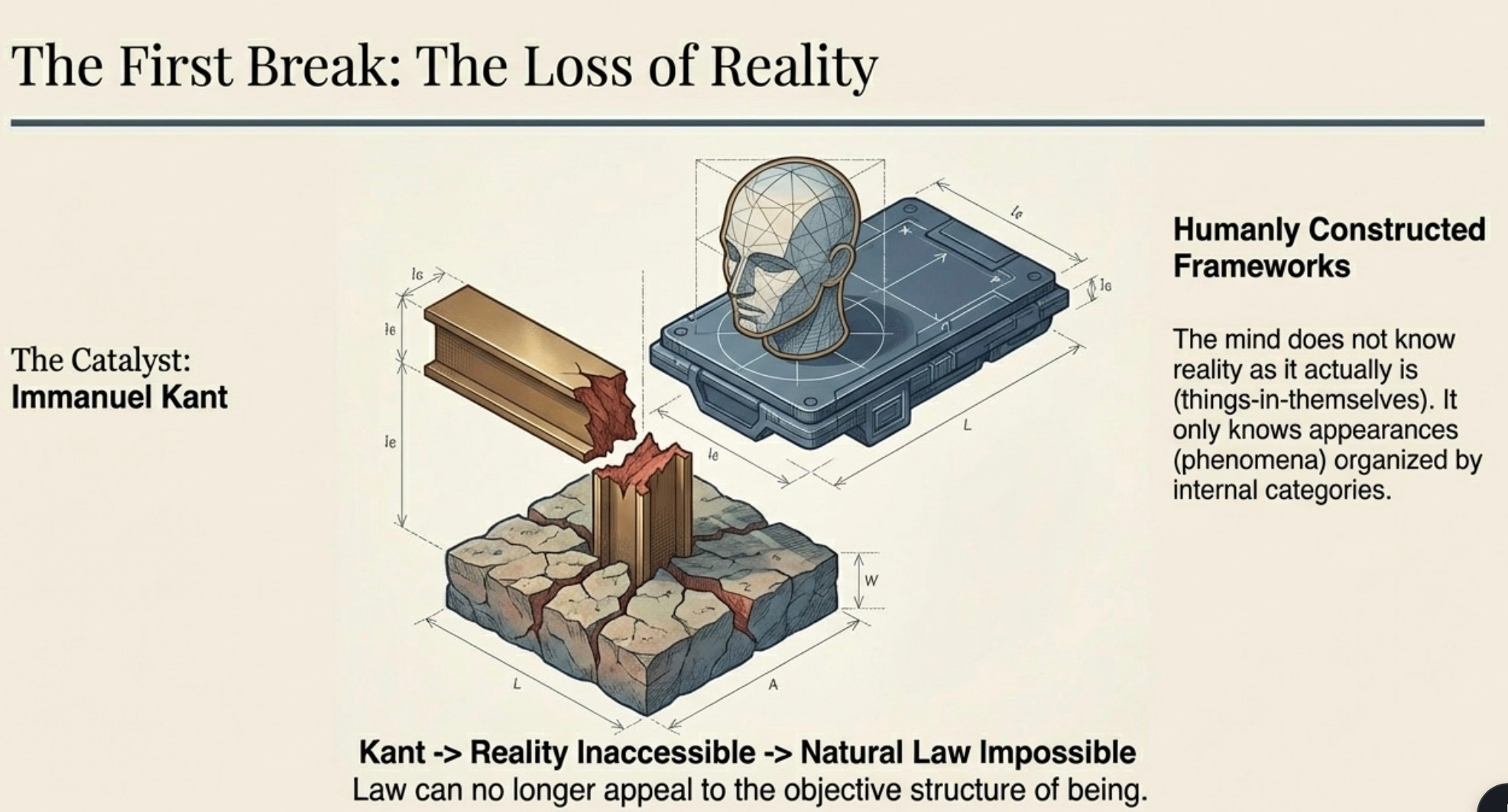
The primary structural vulnerability in contemporary governance is not simply a failure of policy, but an epistemological collapse that has compromised the load-bearing capacity of constitutional law. The critical rupture occurred with the transition from the Common-Sense Realism championed by Thomas Reid (which asserts that reality is directly knowable) to the constructivism of Immanuel Kant. By arguing that the mind only knows phenomena (appearances) rather than things-in-themselves, Kant made objective reality inaccessible to the governing framework. Presuming this to be dusty irrelevant intellectual abstraction is to misunderstand the implications downstream in practise throughout civic infrastructure, institutional and organizational policy and procedure.
Operational Impact Analysis - From Justice to Legality
When reality is deemed inaccessible, Natural Law (grounded in an objective moral order) becomes operationally unavailable. Institutions are forced to transition to ‘Legal Positivism’, where law is no longer a reflection of truth but a humanly constructed framework. As a strategic consequence, the quest for justice is rendered secondary to the maintenance of legality. The system no longer seeks to align with the structure of being; it seeks only to align with its own internal logic.
The Rule-of-Recognition Model
Following the ‘command theory’ of John Austin and the ‘rule-of-recognition’ of H.L.A. Hart, law is now validated solely by the declaration of a ‘recognized authority’. This creates a catastrophic risk for leadership:
Rights as Creations
Rights are transformed from inherent protections of the person into temporary creations of the legal system.
Proceduralism
Leadership loses the ability to adjudicate based on moral reality, defaulting instead to the interpretation of internal administrative procedures.
This metaphysical displacement necessitates a move toward administrative management, where the goal is no longer to uphold truth, but to manage processed outcomes.
The Hegelian Pipeline - Governance as Historical Management
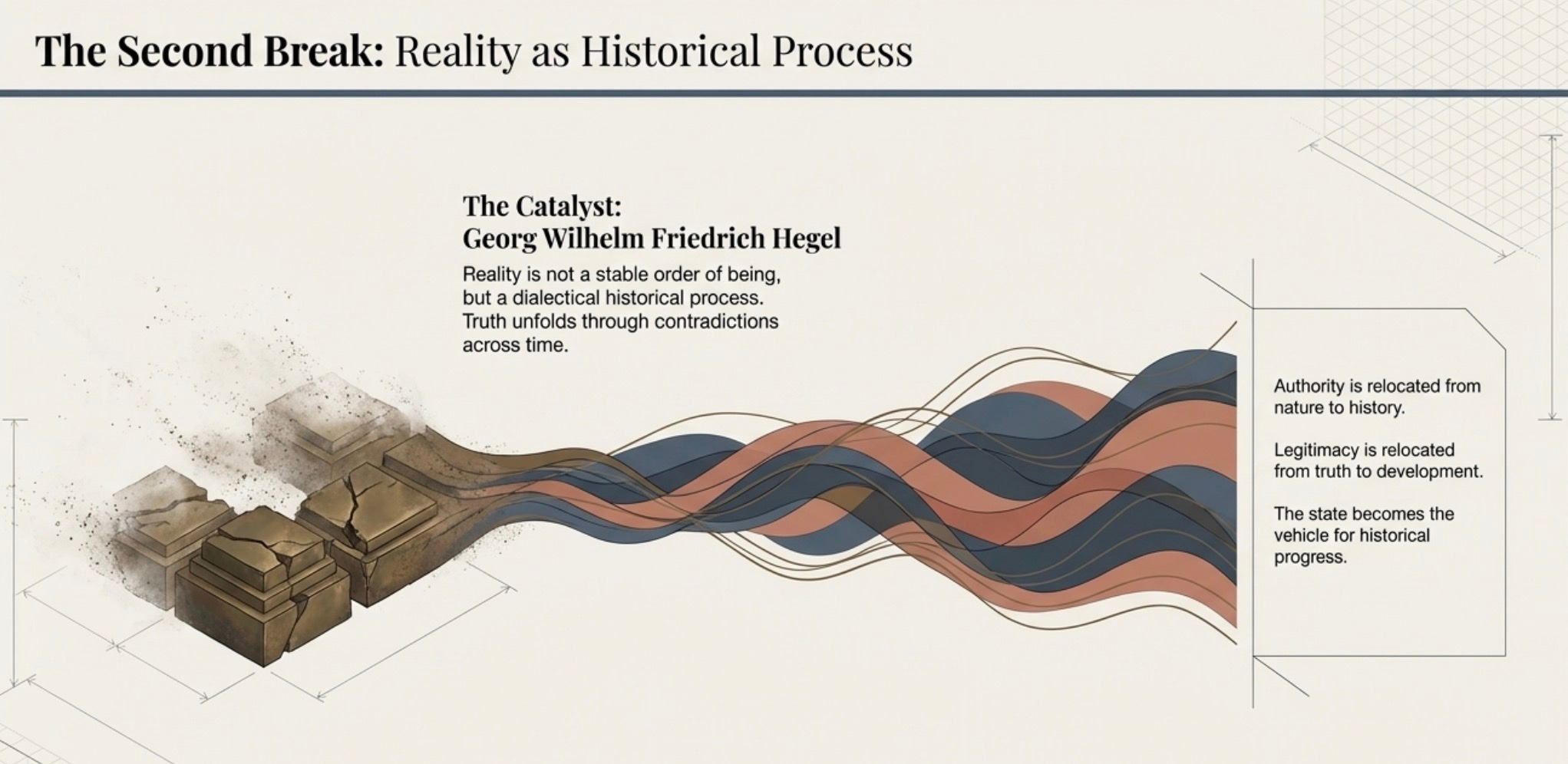
The second vector of institutional erosion involves the relocation of authority from immutable created nature to ‘evolving history’. Under this Hegelian framework, the state is no longer a limited protector of pre-existing rights, but the primary vehicle for historical ‘progress’, with assumed legitimacy deriving from ‘development’ (whatever advances the next stage of ‘social evolution’).
The Administrative State Evolution
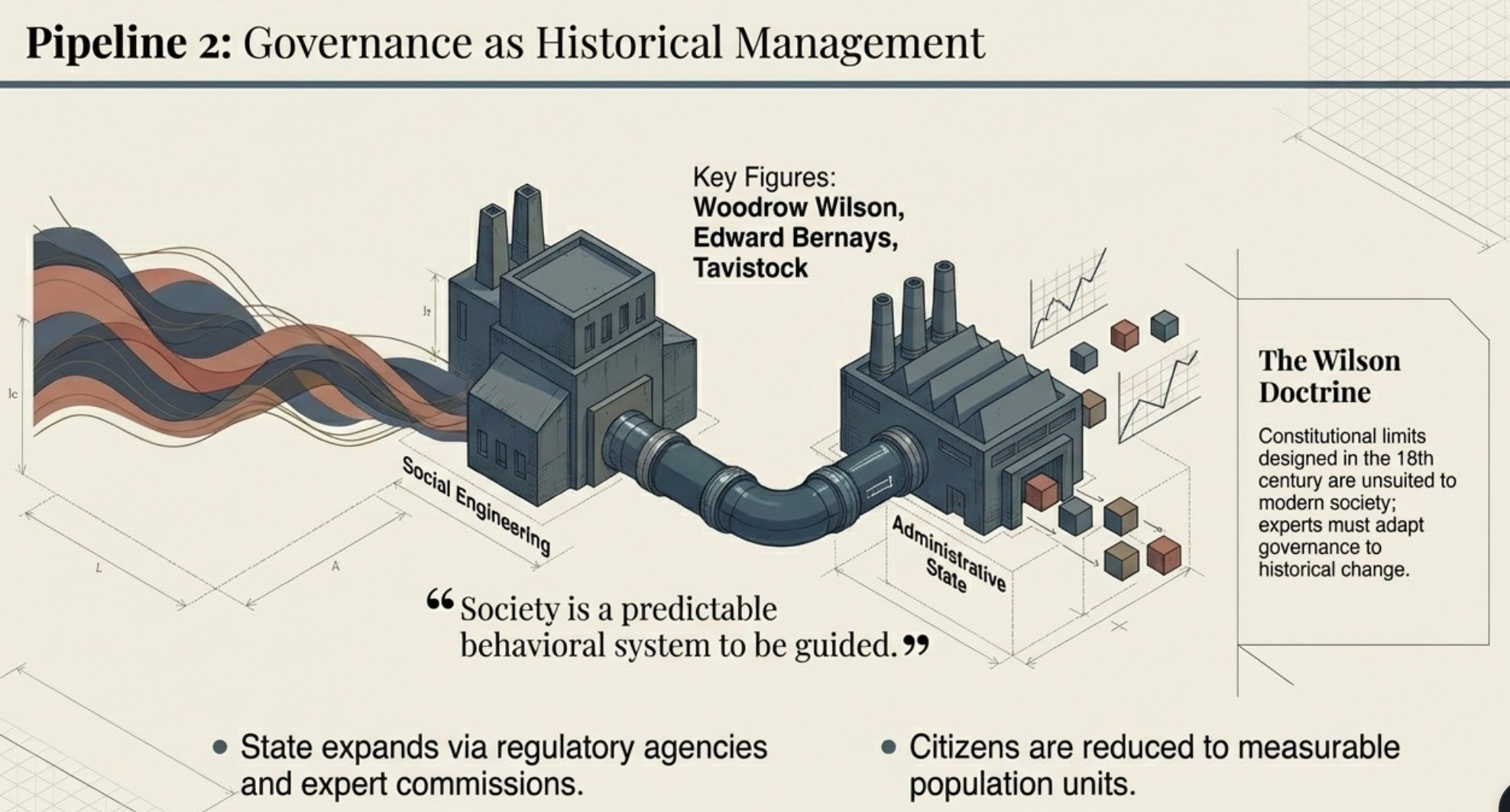
This usurpation was operationalized in the Anglo-American world by (among others) Woodrow Wilson, who utilized Hegelian concepts to argue that 18th-century constitutional limits were ‘no longer suited’ to a modern, evolving society. This necessitated a transition from a limited authority model to an expert administration model. Under this paradigm, governance expands through regulatory agencies and commissions tasked with guiding social evolution through technical expertise rather than fixed law. I’ve mentioned the 1933/4 Carnegie Foundation Commission in partnership with the American Historical Association many times in posts on X and in a number of my previous articles. It was the Blueprint for Revolution to transition America from Independence to Inter-dependence under supranational governance structures, facilitated by the methodologies and pedagogies derived from ‘Social Science’ which are in fundamental conflict with what the Founders established.
Social Engineering and Behavioural Management
To manage the population within this historical pipeline, the administrative state integrates behavioural science and social engineering. Drawing from the propaganda techniques of Edward Bernays and the psychological warfare frameworks of the Tavistock Institute, the system strategically stops treating citizens as moral agents. Instead, they are viewed as predictable behavioural units. Governance thereby becomes a task of shaping incentives and managing outcomes, providing the operational control necessary for the eventual convergence into a singular systems architecture. The current phase of that occurring now under digital systems automation.
The Structural Convergence - The Rise of Systems Governance
In the mid-twentieth century, the Kantian legal pipeline (providing procedural legitimacy) and the Hegelian administrative pipeline (providing operational control) merged into a single governing architecture. This convergence created a system that operates through rules internal to itself, much like how modern medical professionals often default to pharmaceutical intervention over the maintenance of immune function, or how educational pedagogy defaults to social constructivism over the development of endowed rational faculties.
Systems Theory v Moral Order
As analyzed by Niklas Luhmann, society has been redefined as a set of self-referential systems. Law is no longer about justice; it is a subsystem within a network of communications designed to maintain system equilibrium. The governing question has shifted from “Is this just?” to “How can system outputs be optimized?”
Process Optimization as Legitimacy
In this technocratic model, legitimacy is derived from system stability and functional performance:
System Stability
The architecture’s ability to maintain equilibrium despite external pressures.
Complexity Coordination
The efficiency of managing vast networks of information and human behaviour.
Functional Performance
The successful delivery of optimized social outcomes, rendering moral reasoning irrelevant to the system’s operation.
This systems management naturally seeks total automation through digital infrastructure, transitioning from human judgment to algorithmic regulation.
The Theatre of Ideology - Managing Public Perception
The ‘Ideological Conflict’™️ observed in modern discourse™️ is a narrative overlay designed to mask this deep structural transformation. It provides the illusion of apparent public rationale for system expansion, while ensuring that the underlying architecture remains unexamined by a leadership class that has (in many cases) been ‘educated’ out of its awareness, discernment and judgement.
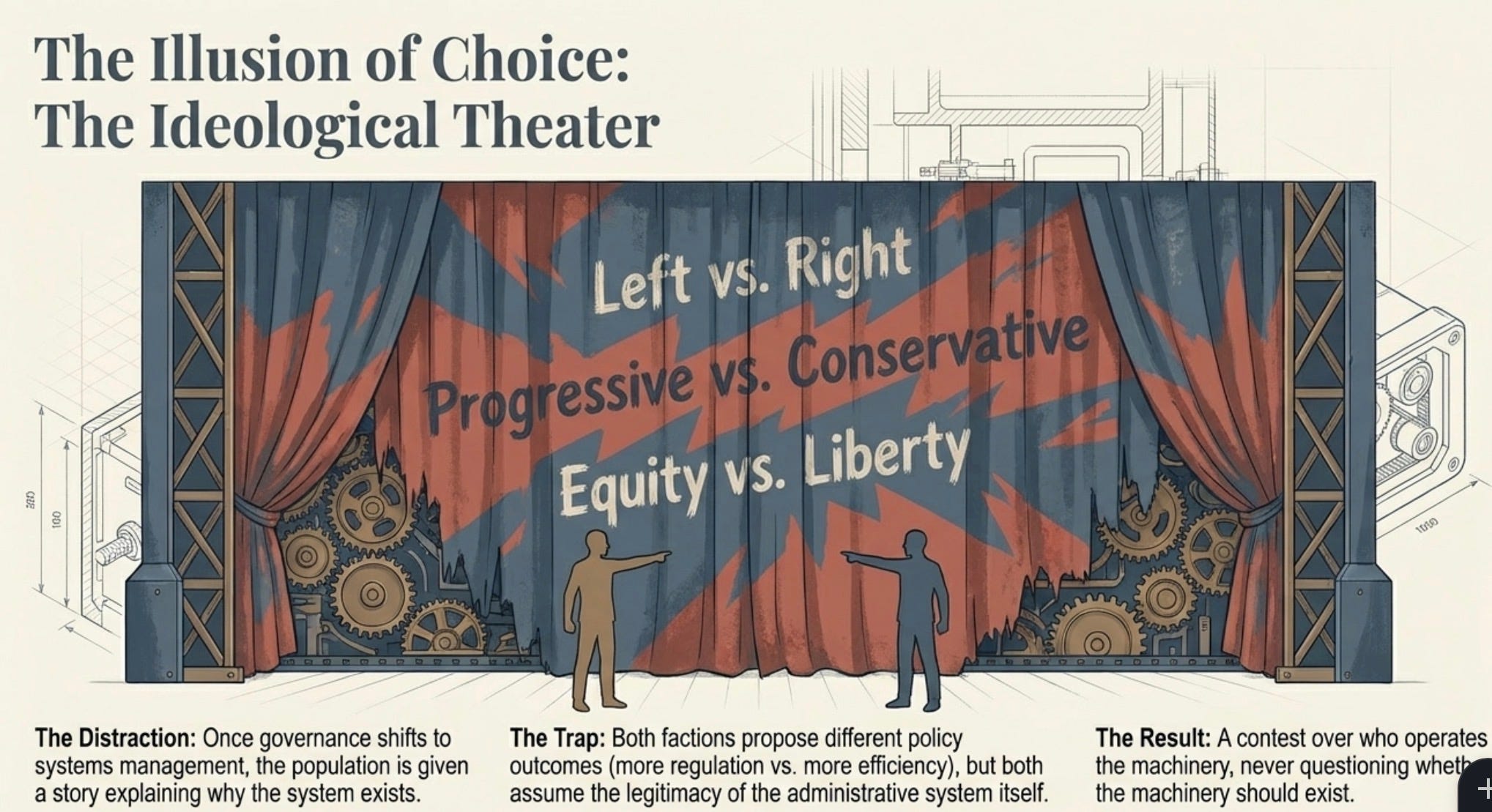
The Functional Utility of Ideological Theatre
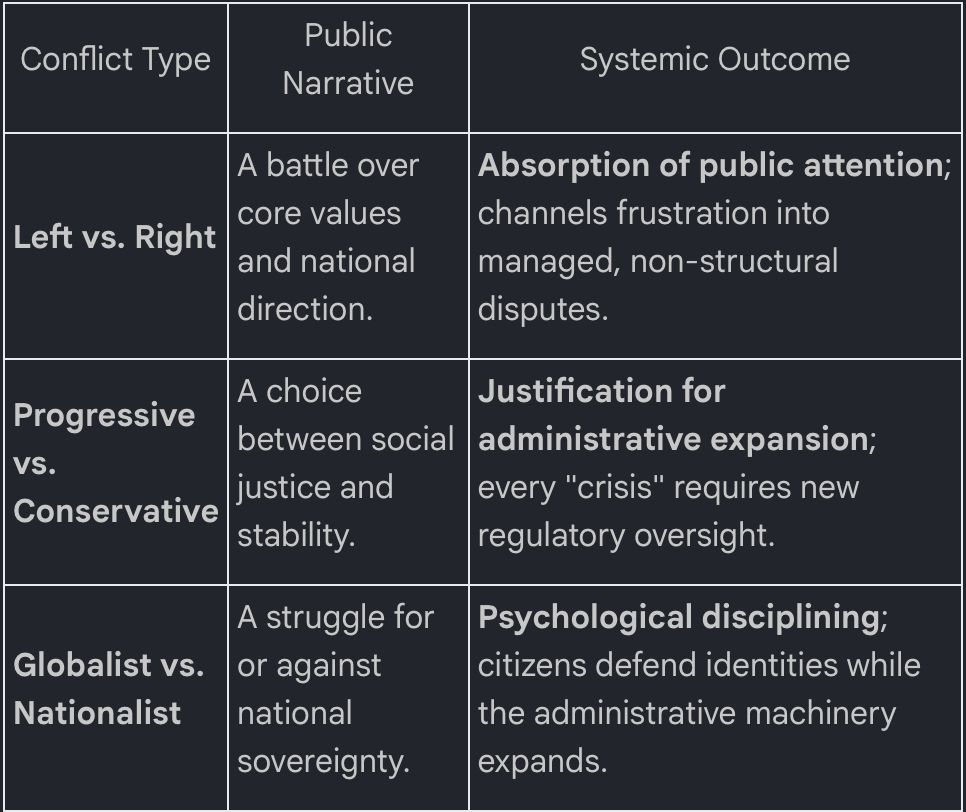
The Redefinition of Rights
Within this theatre, rights are rhetorically maintained but substantively hollowed out. They are no longer limits on power grounded in essential created human nature; they have become ‘regulated permissions’ and ‘policy instruments’. Rights are in practise now conditional privileges granted by the system to achieve specific historical or social outcomes. This creates a state of uninformed consent, where the population facilitates its own subjugation by failing to recognize the operational shift from rights to permissions.
Algorithmic Governance - The Final Operational Phase
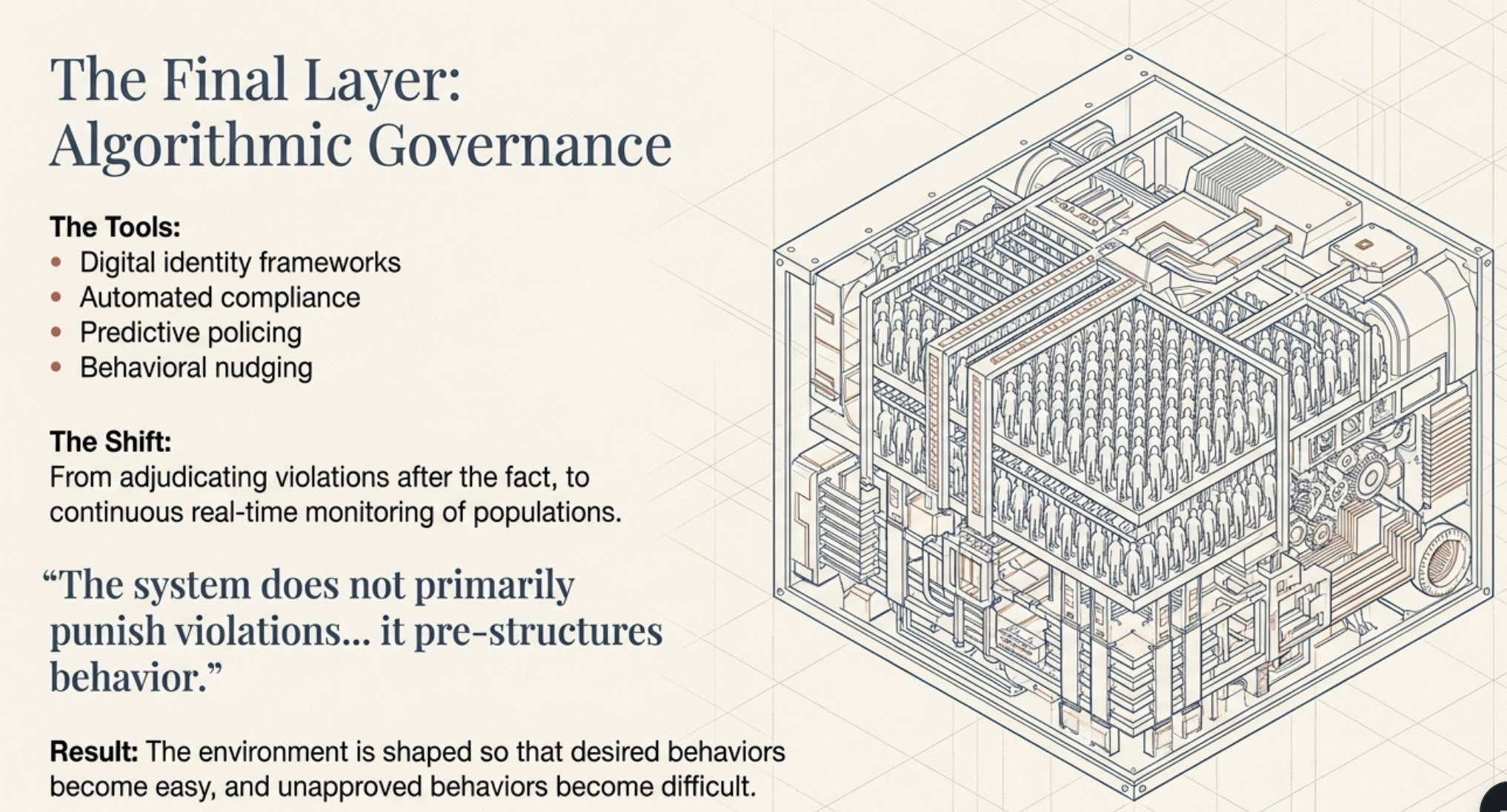
Governance has ‘evolved™️’ into a phase of automated compliance and real-time behavioural management. This is the culmination of treating society as a system to be optimized through continuous instrumental technological infrastructure.
Pre-Structuring Behaviour v Adjudication
There is a fundamental seismic shift from punishing violations after the fact to pre-structuring behaviour in real-time. Through algorithmic regulation and digital identity frameworks, the environment is shaped so that non-compliant behaviours are rendered impossible. This removes the need for traditional legal adjudication; when compliance is built into the digital architecture of society, the concept of a trial or defence becomes obsolete.
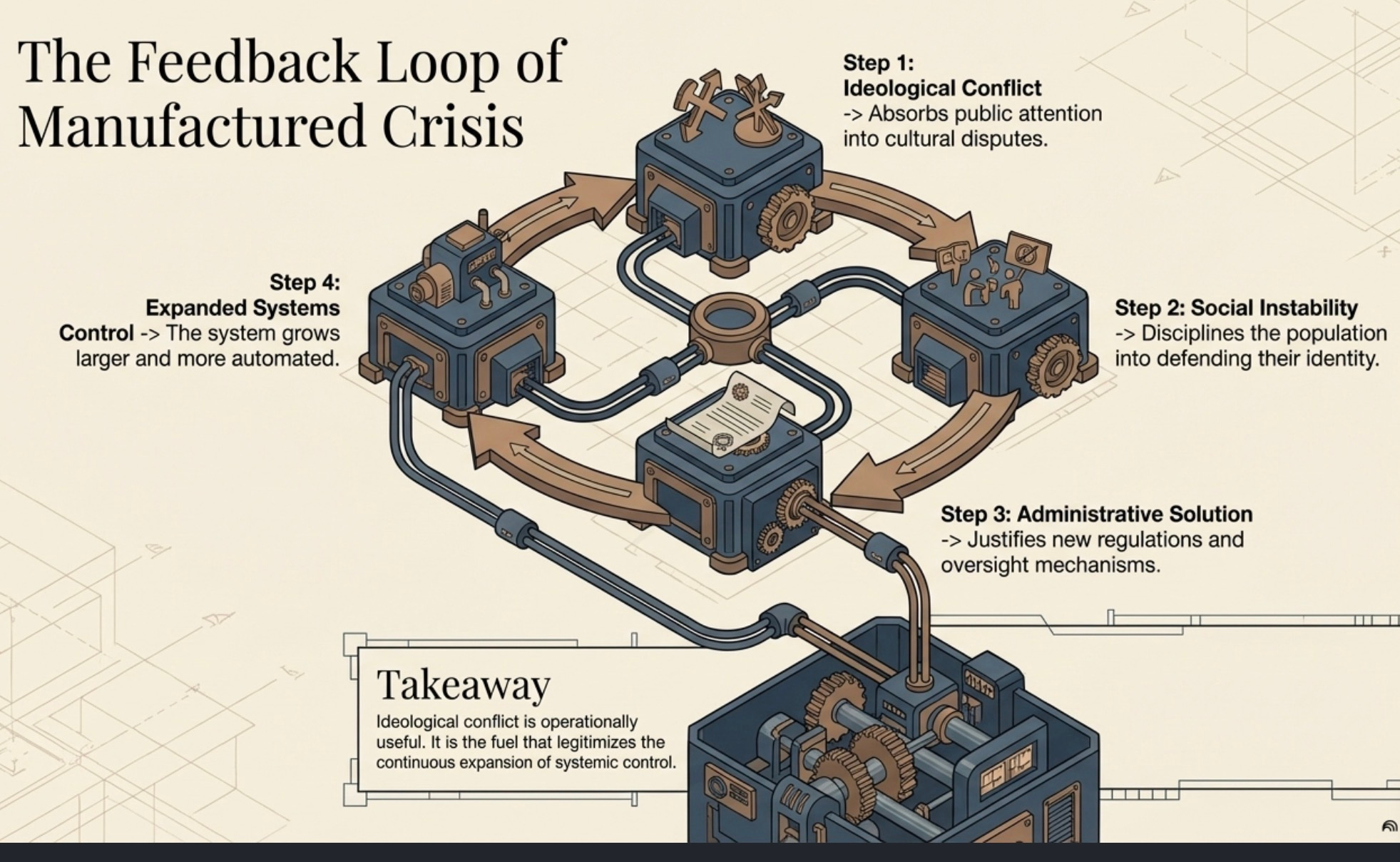
Technocratic Systems Management
The final layer of control is defined by:
Continuous Monitoring
Real-time data collection on every ‘population unit’.
Predictive Behavioural Governance
Using statistical modelling to anticipate and mitigate non-compliant actions before they occur.
Automated Enforcement
Systems that apply regulatory pressure through platform architecture without human intervention.
All of which capitalizes on the usurpation of ontological realism with Bernays’/Tavistock’s ‘Consumer’ ontology, which I wrote about at length in this 4-part series (with the accompanying 4-part audio fable series to dramatize the implications and consequences) which can be read and listened to here:
Critical Vulnerability Analysis - The American Constitutional Order
The American system, grounded in the philosophical realism of figures like Founders James Wilson, John Witherspoon and James Madison (all drawing on the ontological realism of Thomas Reid), is the final roadblock to a World Federation™️ architecture. There is a fundamental incompatibility between a system that treats government as a servant constrained by objective reality and one that treats government as the manager of a historical process.
Foundational Contrasts
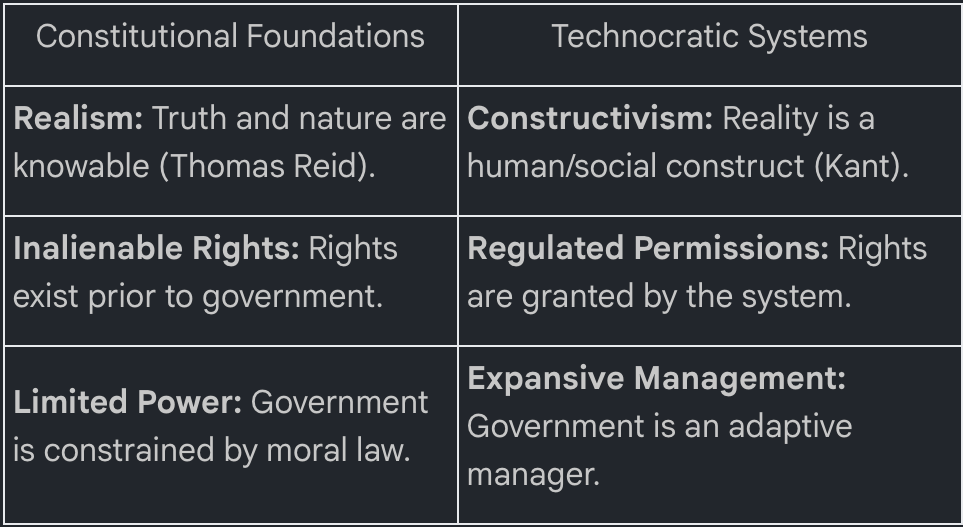
The Diagnosis of Institutional Failure
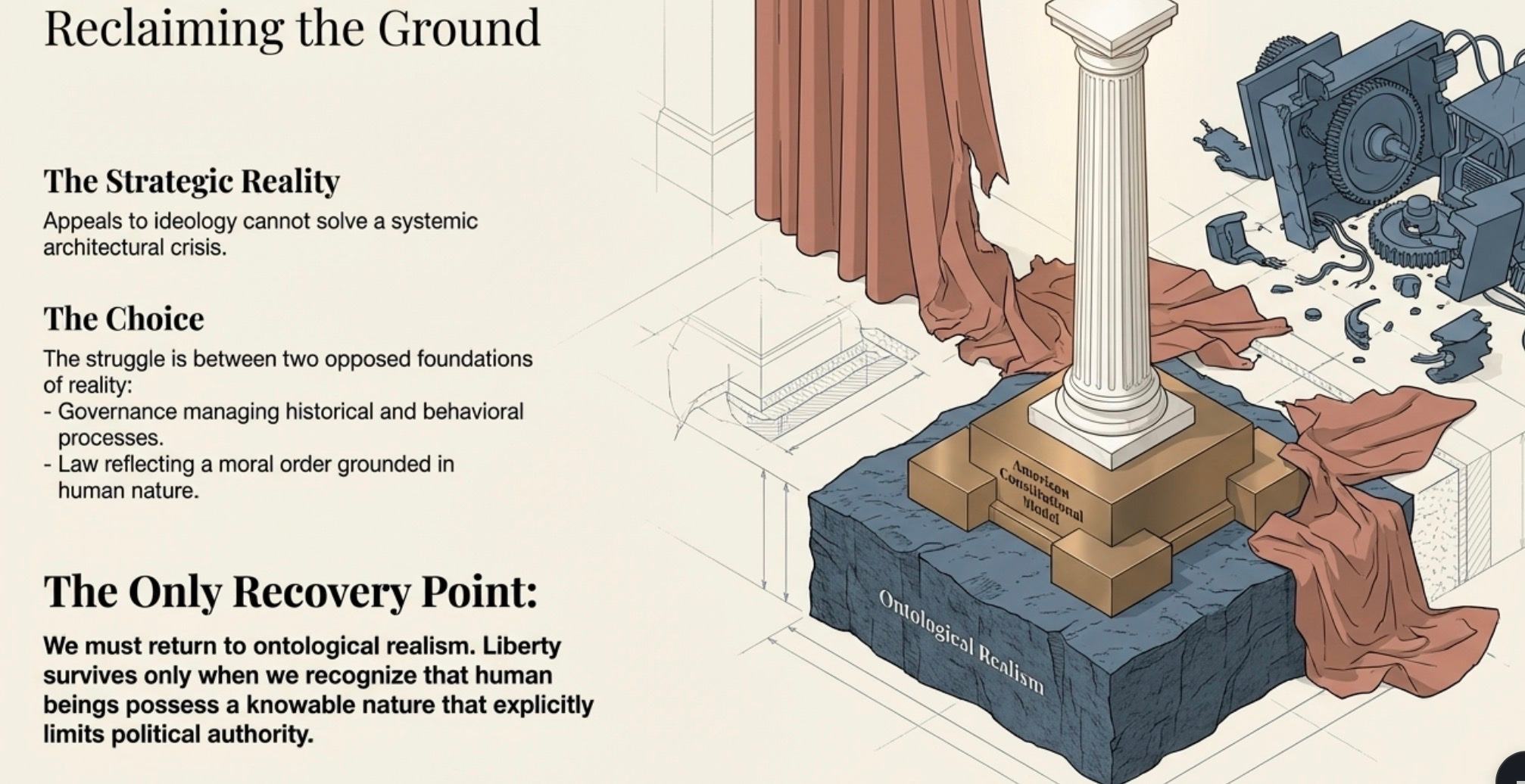
The strategic peril is that the American system is currently denying the ground it needs to stand upon - and has been trained over generations to do so. By adopting the operational methods of systems management while retaining only the rhetoric of constitutionalism, the institution invites total structural failure. If the ontological foundation of essential created human nature is lost, the American instrument for fighting ideological conquest and technocratic subjugation is neutralized.
Restoring the Ground
Institutional sovereignty cannot be preserved through policy alone; it requires the restoration of the metaphysical ground. Without a commitment to the knowability of reality and the immutable nature of the human person, constitutional language becomes a hollow shell for technocratic control.
Final Directive for Leadership
To distinguish between political theatre and structural erosion, leadership must apply these principles:
Prioritize Ontology over Procedure
Evaluate all actions based on whether they treat citizens as moral agents with an inherent nature or as units in a behavioural system.
Reject Procedural Legitimacy
Recognize that ‘legal’ mandates are structurally invalid if they contradict the objective moral order.
Halt Algorithmic Encroachment
Identify and dismantle systems that replace human adjudication with automated, pre-structured compliance.
Uphold, Steward and Defend the Grounded Instrument
Recognize that the American Founding framework was established For All Men; For All Time - an immutable covenant, not a construct/contract to be managed.
The fundamental struggle of our era is between two opposed understandings of reality:
one grounded in the immutable created nature of humanity - human
the other in the managed processes of an algorithmic system - post human